I don’t know how American Literature is taught today, nor how contemporary scholars evaluate the literary giants of 19th century New England.
When I was at university, the works of writers clustered around greater Boston were celebrated as a great leap forward toward a distinctive American voice in literature.
I respected the essays of Emerson (recognizing their importance in post-Puritan thought and sensibility), but I loved the short stories of Hawthorne and read them repeatedly.
Through the early 20th century, as we have seen in other postcard stories, educated travelers paid homage to the legacy of New England literary figures when they visited Massachusetts.
+ + + + + + +
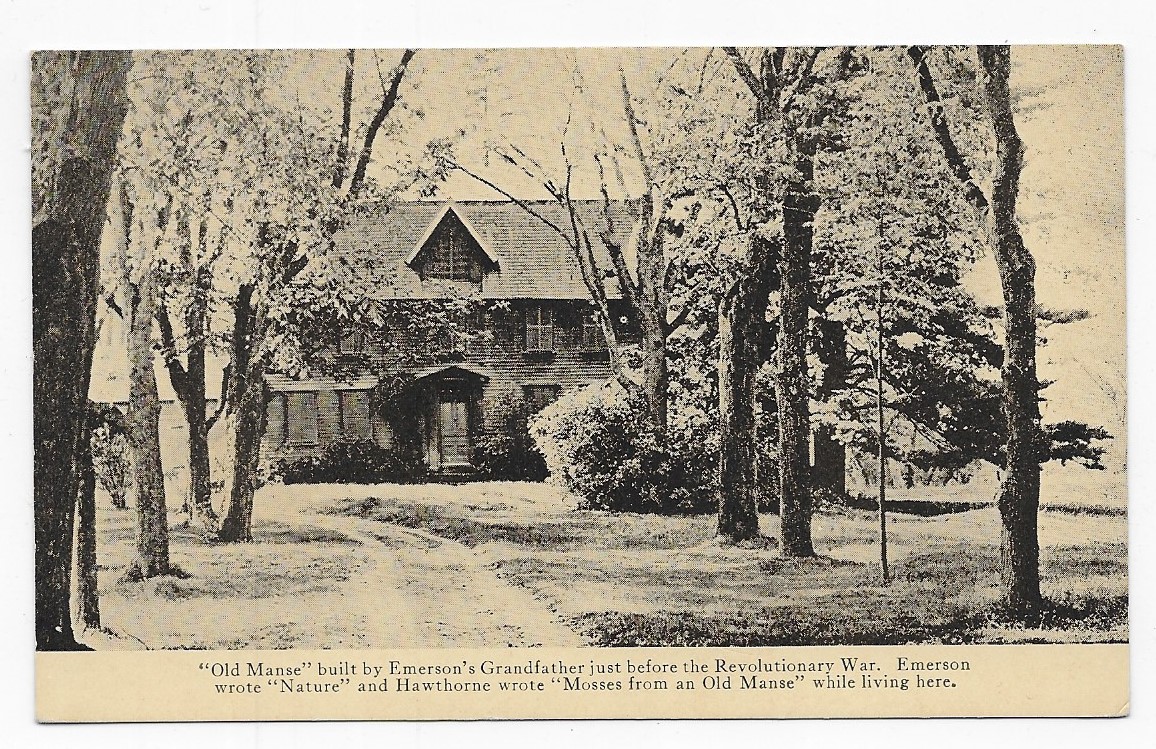
This postcard is an uncolored photograph of “The Old Manse” in Concord, Massachusetts.
https://en.wikipedia.org/wiki/Concord,_Massachusetts
The building was erected in 1770 for the Rev. William Emerson, the Congregational minister of Concord.
https://en.wikipedia.org/wiki/The_Old_Manse
The original occupant was the father of another Rev. William Emerson, and the grandfather of the Transcendentalist writer and lecturer, Ralph Waldo Emerson.
https://en.wikipedia.org/wiki/Ralph_Waldo_Emerson
The elder Rev. Emerson died in 1777, but his widow married the new minister, the Rev. Ezra Ripley, and the Emerson family continued to live in the house.
Ralph Waldo Emerson moved to Concord in 1834 and lodged at the Old Manse with his aged step-grandfather, Rev. Ripley.
While there, Emerson completed the first of his essays on Transcendentalism, “On Nature”.
https://en.wikipedia.org/wiki/Nature_(essay)
In 1842, Nathaniel Hawthorne and his new wife, Sophia Peabody, set up housekeeping in the Old Manse – which they rented for $100 per year.
https://en.wikipedia.org/wiki/Nathaniel_Hawthorne
(Henry David Thoreau planted a vegetable garden there as a wedding gift to the couple.)
About twenty sketches and tales were composed and published by Hawthorne while he resided at the Old Manse.
In 1845, the Old Manse was reclaimed by the Ripley family; It remained in possession of Emerson and Ripley descendants until 1939 when it became part of a trust that preserves the home and contents as a museum.
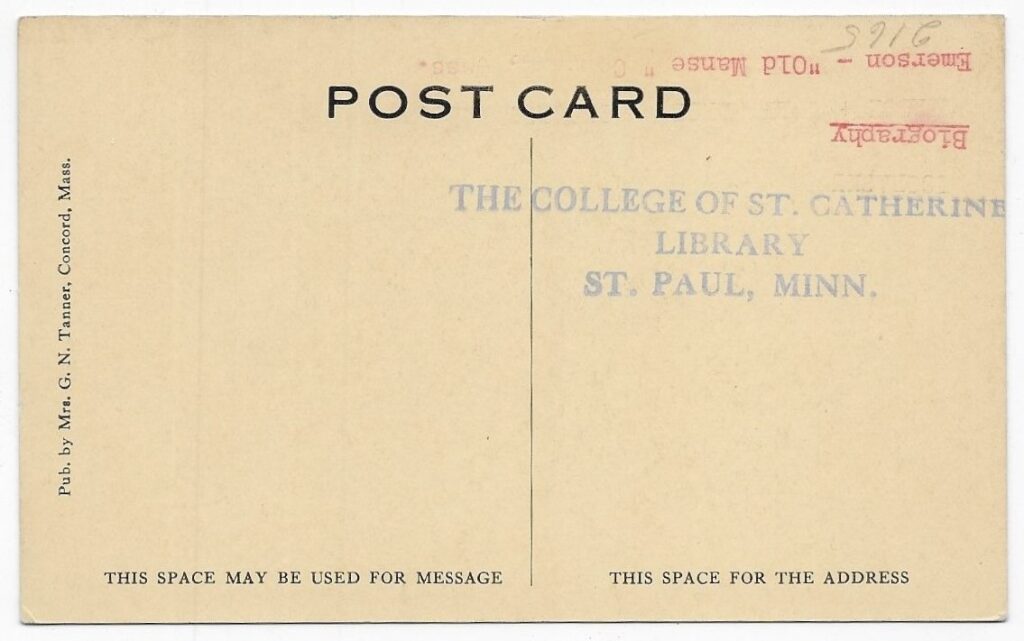
This postcard was published by Mrs. G. N. Tanner of Concord.
+ + + + + +
The postcard was not mailed, but does have an interesting history.
It was part of a collection of images at the College of St. Catherine in St Paul, Minnesota.
https://en.wikipedia.org/wiki/St._Catherine_University
I purchased the postcard (for 25 cents) as an example of the hundreds of thousands of postcards that were once assembled in library collections,
If you go browsing through the paper goods offered by antique dealers today, you may find hundreds of postcards that have been de-accessioned as Library collections have been digitalized and images have become immediately accessible through electronic devices.
I hate to see postcards discarded, especially those that may have been borrowed by students who were struggling to complete their essays on Emerson or Hawthorne.