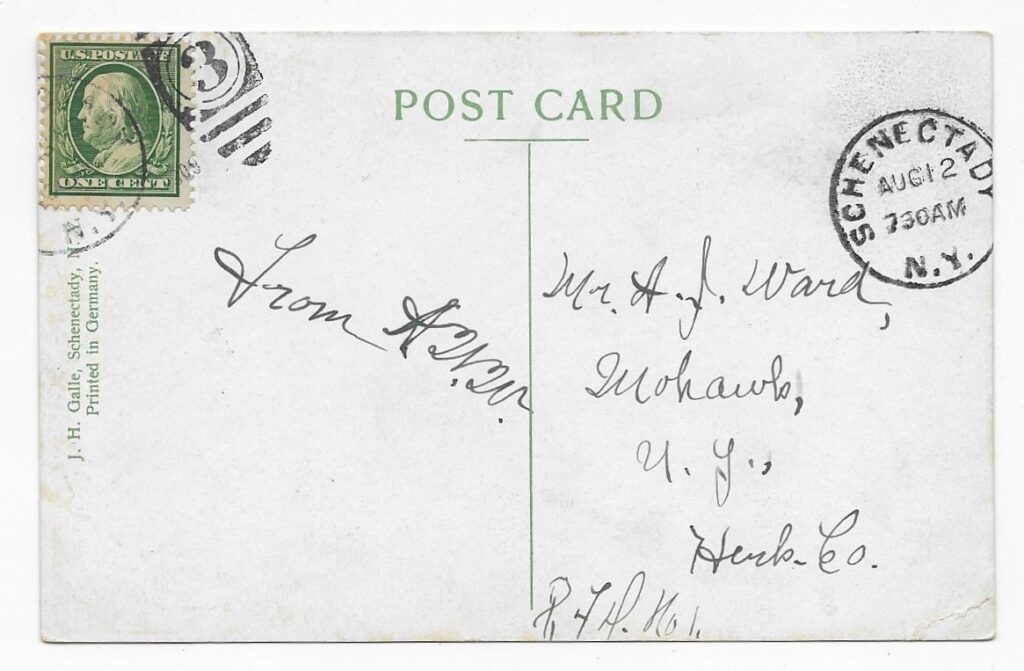
Mr. A. J. Ward lived in Mohawk, a village on the Mohawk River in Herkimer County of central New York State.
https://en.wikipedia.org/wiki/Mohawk,_Herkimer_County,_New_York
It is near the town of German Flatts – the interesting history of which we discussed in a postcard story related to Fort Herkimer: “A Church for the Fort”.
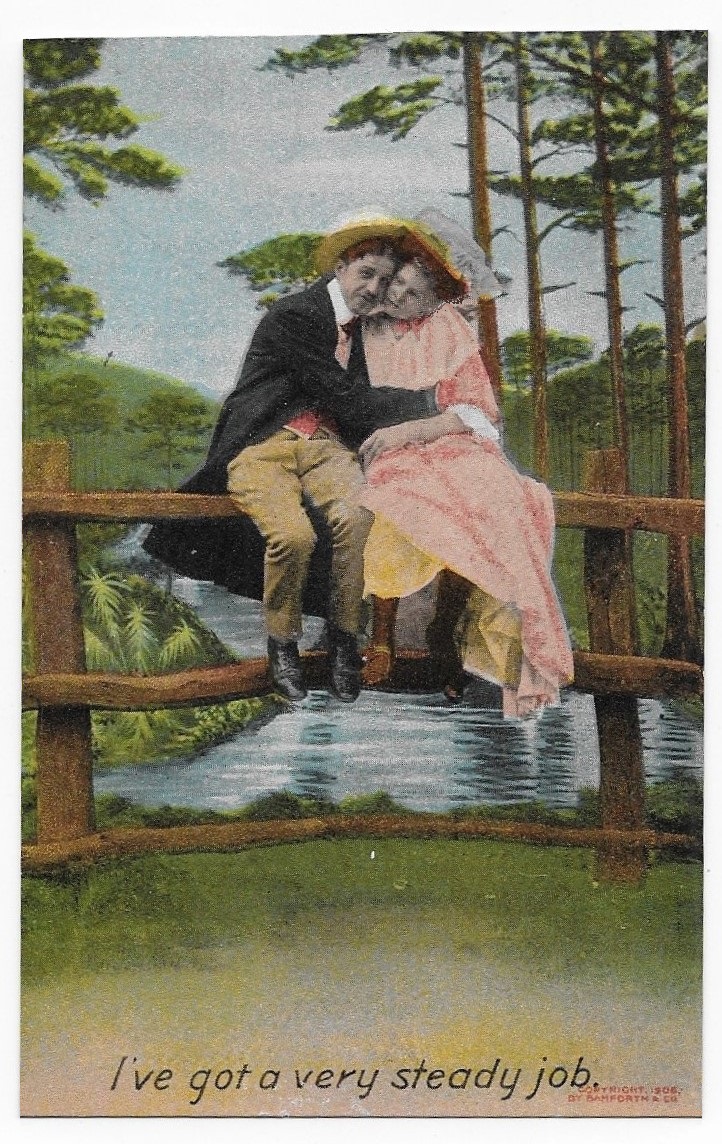
In August of 1909, Mr. Ward received a postcard “A. W. W.”.
The postcard was mailed from Schenectady, but there is no other information about either correspondent.
Schenectady, at the confluence of the Mohawk and Hudson Rivers lies about 15 miles northwest of Albany, and about 65 miles southeast of Mohawk.
While the first European settlers in this area were Dutch farmers who tilled small plots along the Mohawk River, Schenectady grew rapidly throughout the 19th century as a center of industry and trade.
https://en.wikipedia.org/wiki/Schenectady,_New_York
+ + + + + + +
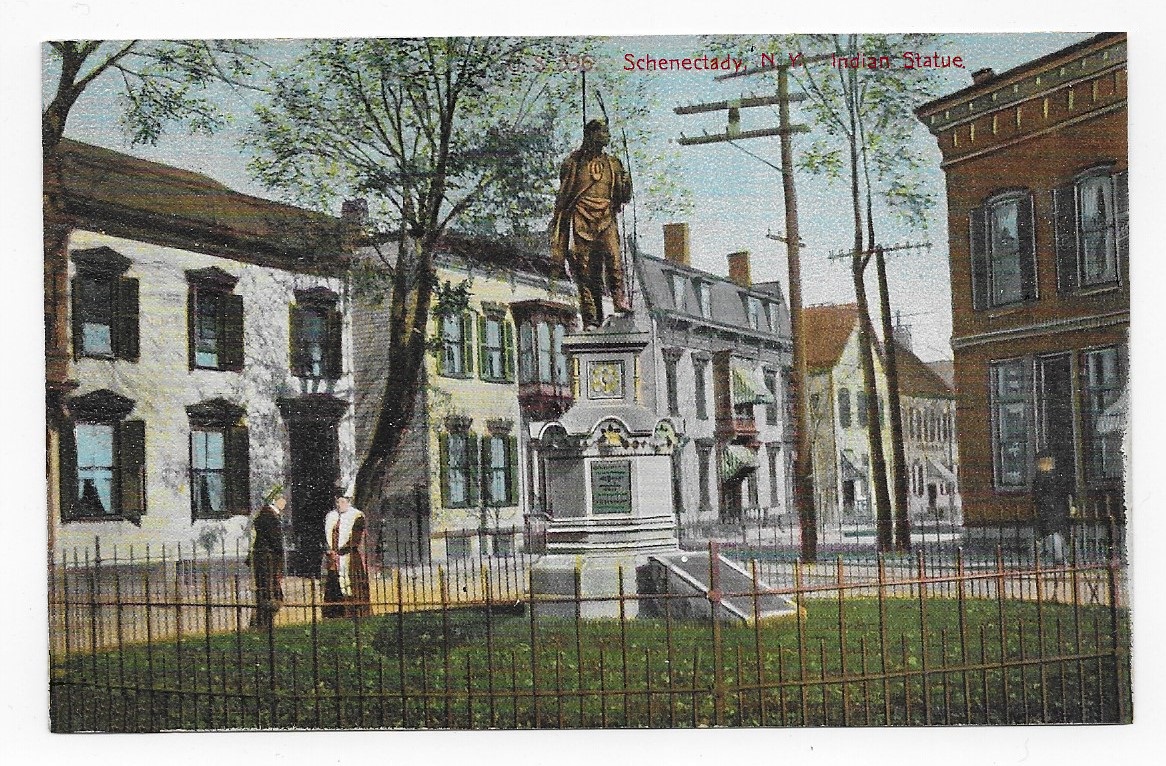
At the intersection of several streets, at what was once the “Stockade” of the early settlement, a statue was erected by the city of Schenectady in 1887.
The figure of a Mohawk chieftain, cast by the J. L. Iron Works of the Bronx, stands watch over the old city.
Initially, the statue was not named, and early references (official and unofficial) refer to “The Indian”.
Indeed, the statue was not unique; the Iron Works named it “Indian Chief #53” and produced at least 25 identical statues for placement in other parts of the US.
In the beginning, the Indian Statue had basins near the base which were used to water horses.
There are several archived photographs and postcard views of this statue in this informative blog of the Schenectady County Historical Society :
https://gremsdoolittlelibrary.blogspot.com/2013/09/a-stockade-icon-lawrence-indian.html
“It wasn’t until 1962 that Lawrence was given his current name. He was named for “Lawrence the Maquase,” a Mohawk who led a party that attempted to recover Schenectadians captured during the 1690 Massacre.”
The 1690 event, part of what Europeans call “King William’s War”, was a surprise attack by French forces and allies from other indigenous tribes.
Lawrence was a Christian, and well-respected within the city of Schenectady.
(Since the time of early Dutch settlements in the Hudson River Valley, there had been significant cultural exchanges between Mohawk and European peoples.)
The accounts of Lawrence’s agency on behalf the early settlement are recorded by contemporaries; they are not local legends of recent origin.
But it is unfortunate that the only documents related to the life of Lawrence are recorded remarks and the observations made by non-native settlers.
Like many other Mohawk people, Lawrence would have had to navigate the uncomfortable intersection and many conflicts of ancient and new civilizations in central New York State.
This postcard photograph was published by J. H. Galle of Schenectady, and printed in Germany.