Mrs. Barton Warner lived in Rocky Ridge, an unincorporated community in Frederick County of north-central Maryland.
The small community grew up around the intersection of two roads, and later became a junction of the Western Maryland Railway and the Emmitsburg Railroad.
https://www.emmitsburg.net/archive_list/articles/places/land/rocky_ridge.htm
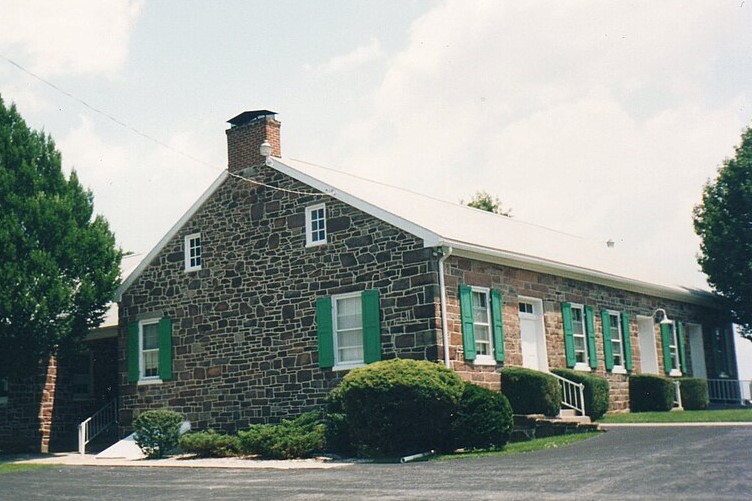
An historic stone church, the Monocacy Church of the Brethren, is the oldest building in the community.
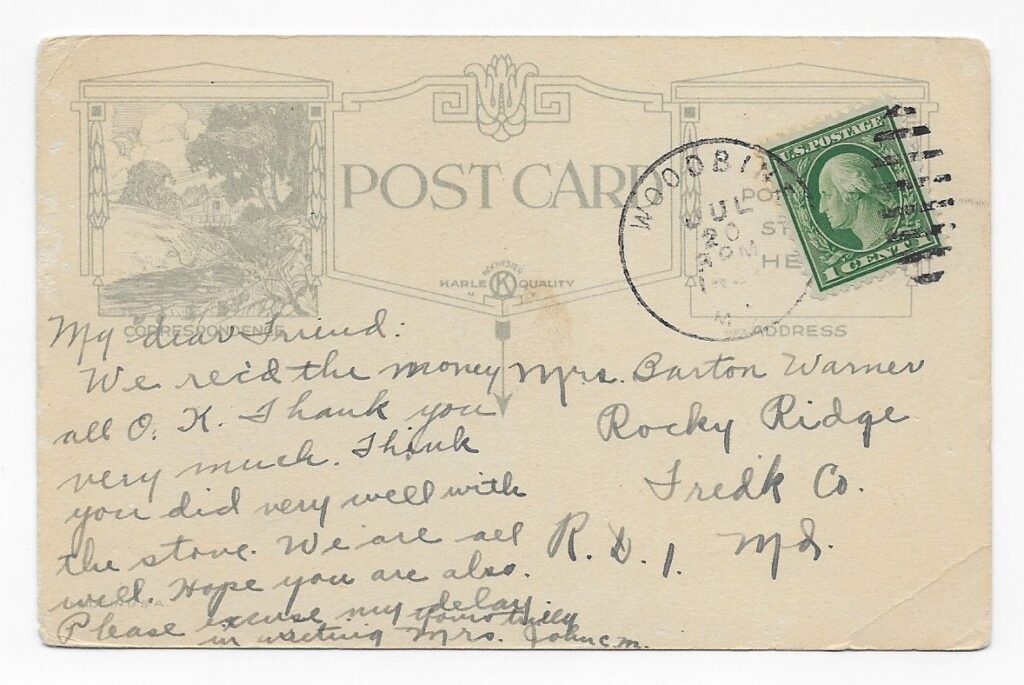
In July of a year near 1914, Mrs. Warner received a postcard from Mrs. Johnson.
The postcard was mailed from Woodbine, an unincorporated rural community straddling the Patapsco River in Howard and Carroll Counties – southeast of Frederick, Maryland.
During the Civil War, Confederate cavalry crossed the river at Woodbine before the Battle of Gettysburg.
https://en.wikipedia.org/wiki/Woodbine,_Maryland
Rocky Ridge is about 27 miles northwest of Woodbine.
+ + + + + +
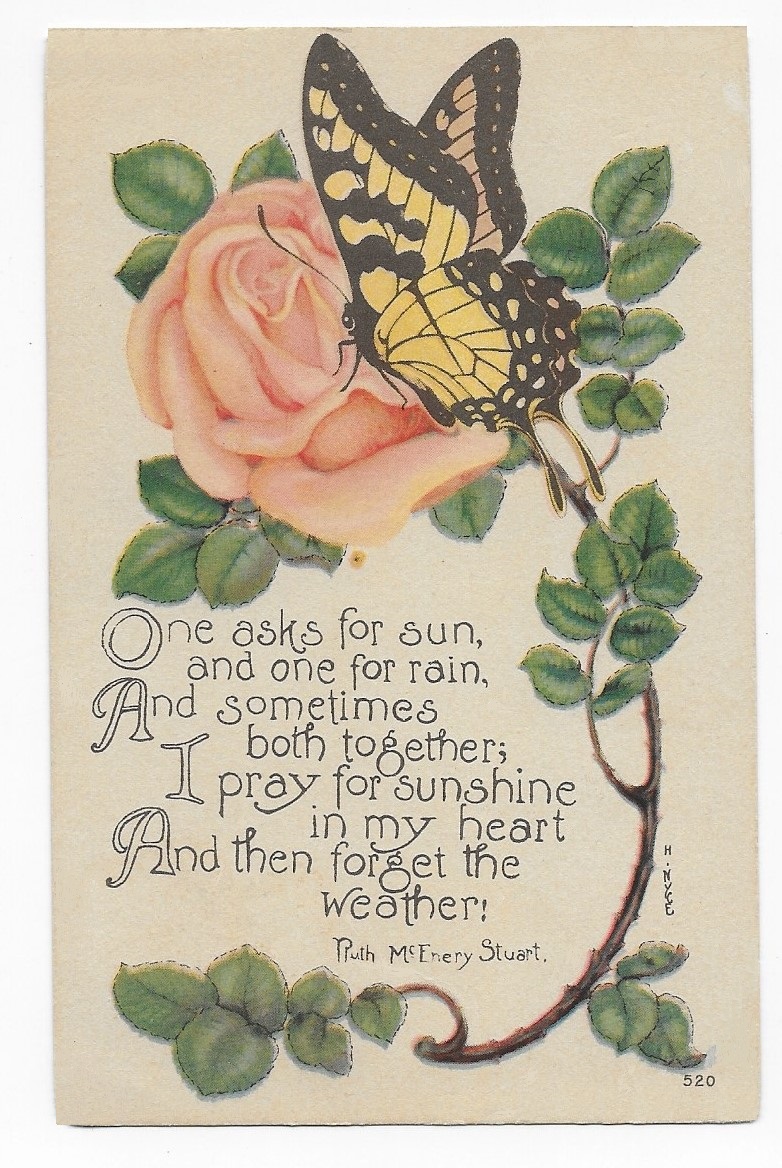
The face of the postcard displays a drawing of a butterfly alighting on a long-stemmed rose.
The curl of the stem encloses a short verse.
Unusually, the artwork is credited, in this case to H. Nyce.
The lines of verse describe how one asks for sun and one for rain – but the writer recommends a prayer for sunshine in the heart that leaves one indifferent to the weather.
“One asks for sun,
And one for rain,
And sometimes both together;
I pray for sunshine
in my heart
And then forget the weather.”
The verse is attributed to Ruth McEnery Stuart.
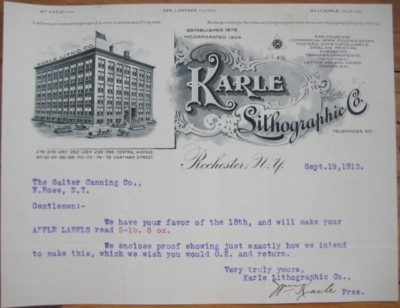
The postcard was published by the Karle Company of Rochester, New York.
I believe that this is the Karle Lithograph Company, but I have not found a history of the company.
+ + + + + +
On the reverse, Mrs. Warner is addressed as “My Dear Friend”.
Mrs. Johnson acknowledges receipt of money, and opines, “…you did very well with the stove.”
This may suggest that Mrs. Warner had purchased a stove, or paid for installation, from Mrs. Johnson.
The postcard message continues with a report that “we are all well” and a “hope that you are also”.
In closing, the writer apologizes for the delay in acknowledging the payment. Because the pretty postcard was preserved in very good condition for a century, I assume that the correspondents had a relationship beyond a commercial transaction.