I lived and worked in the Twin Cities for several years in the last century. It is a great place, with a distinguished history of good government and high-levels of community engagement. The terror unleashed on these good people during 2025-2026 is horrifying to me.
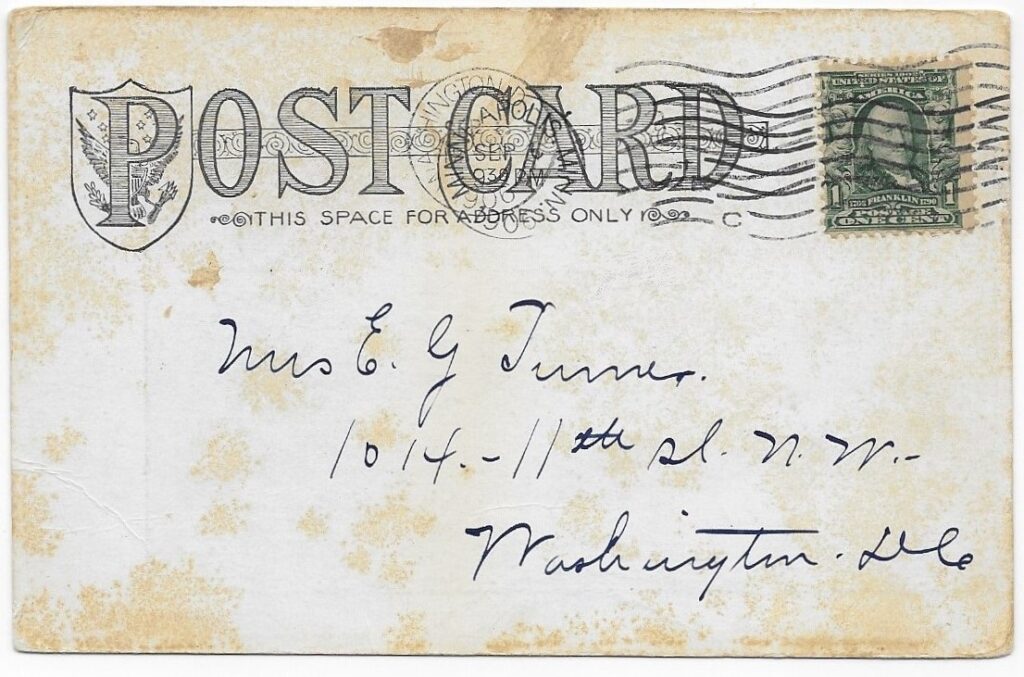
Miss E. Y. Turner lived in the northwest section of Washington, D.C, not far from the city center.
Her home at 1014 11th Street NW no longer exists -large office buildings now cover this block near Mt. Vernon Square.
https://en.wikipedia.org/wiki/Mount_Vernon_Square
In September of 1906, Miss Turner received a postcard from a correspondent in Minneapolis.
Minneapolis, the larger half of the Twin Cities, grew on the western bank of the Mississippi River, near the confluence of the Minnesota River and near the early military installation of Fort Snelling.
https://en.wikipedia.org/wiki/Fort_Snelling
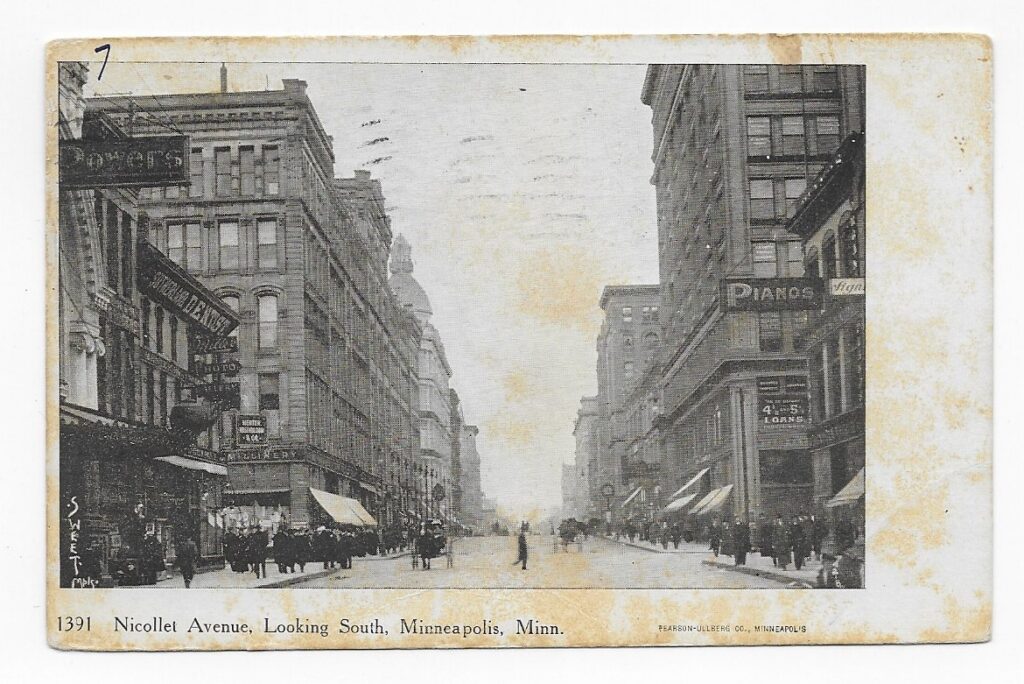
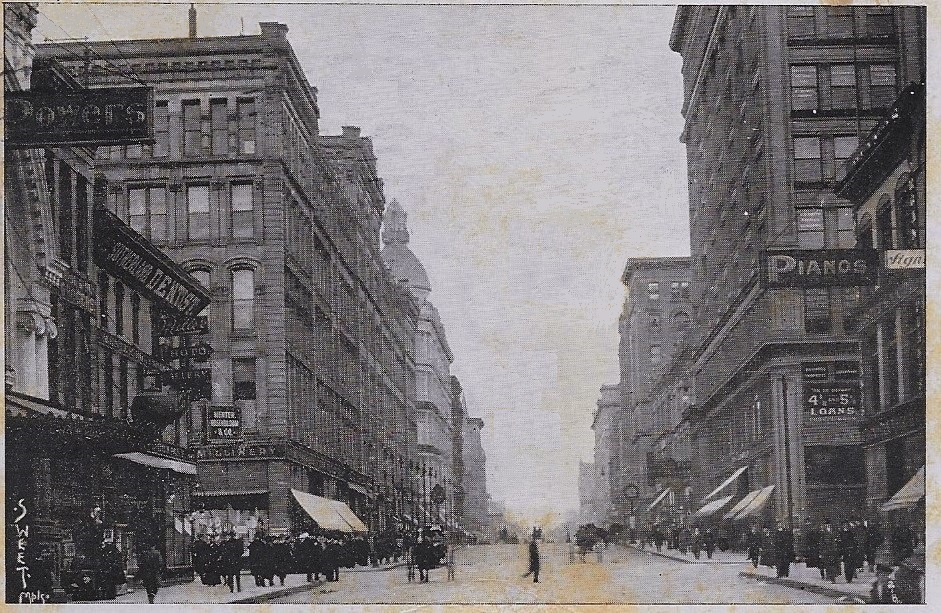
The building “canyons” in the central business district (shown on the postcard) demonstrate that Minneapolis remains a hub for industry, commerce, finance, culture, and transportation for the northern Great Plains and the upper Mississippi Valley.
(Giant grain elevators still line parts of the Mississippi River where early mills and bakeries have grown into national food conglomerates.)
https://en.wikipedia.org/wiki/Minneapolis%E2%80%93Saint_Paul
The writer did not inscribe initials or any other identification on the postcard.
+ + + + + + + +
The face of the postcard is a photograph of “Nicolllet Avenue, Looking South”.
The avenue is named for the French scientist, explorer and cartographer, Joseph Nicollet, who led three expeditions through the area in the 18th century.
https://en.wikipedia.org/wiki/Joseph_Nicollet
One of the main thoroughfares in the city of Minneapolis, Nicollet Avenue passes through several distinct neighborhoods and communities.
Throughout the 19th and early 20th century, Minnesota received large waves of immigration from Scandinavia which has profoundly shaped the civic culture.
Today, Minneapolis embraces significant refugee populations from war-ravaged areas of the world.
https://en.wikipedia.org/wiki/Nicollet_Avenue
Against the disruptions of blizzards that blow rapidly into the city from the west, Minneapolis today has a series of enclosed skyways that connect stores, concert halls, and civic buildings to large underground parking garages.
https://en.wikipedia.org/wiki/Minneapolis_Skyway_System
+ + + + + +
Because the postcard has an “undivided back”, there is no message on the reverse.
We know that Miss Turner preserved the postcard throughout her life.