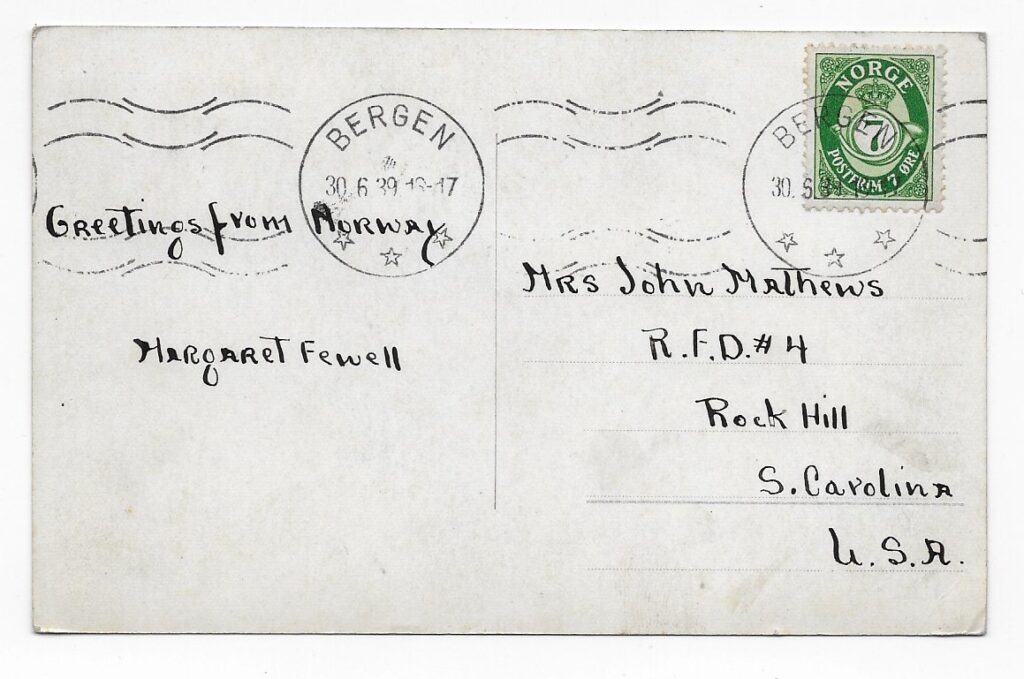
This postcard was mailed from Bergen, Norway on June 30, only 60 days before the German blitzkrieg against Poland ignited World War II (on September 1, 1939).
The Nazi occupation of Norway began on April 9, 1940.
Mrs. John Mathews lived in Rock Hill, the pretty town on the Catawba River in York County of north-central South Carolina.
Although there were European settlers in the area by the 1830’s, the town of Rocky Hill was not established until the Charlotte & South Carolina Railroad built a line through the area in 1852.
https://en.wikipedia.org/wiki/Rock_Hill,_South_Carolina
Cotton was grown in the area around Rock Hill and one half of the town’s population was enslaved at the outbreak of the Civil War.
Wartime scarcity initiated the change in agricultural production from cotton to corn.
Today, the city of Rock Hill is home to three colleges, and a significant historic district.
+ + + + + +
In early July of 1939, Mrs. Mathews received a postcard from Margaret Fewell.
The postcard was mailed from Bergen, the city on the west coast of southern Norway.
Bergen was founded in the early 11th century, about the time that Viking excursions into England were finally suppressed.
The first capital of Norway, Bergen today is a major port and a center of trade, shipping, aquaculture, and industry associated with deep-sea oil extraction.
https://en.wikipedia.org/wiki/Bergen
+ + + + + +
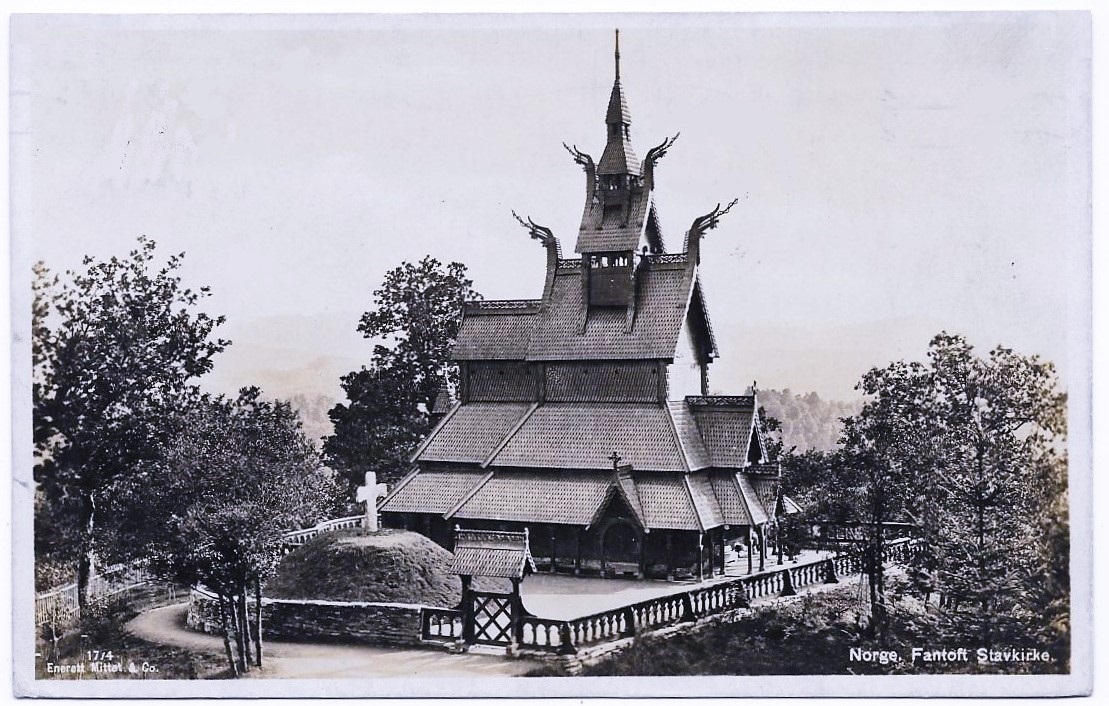
The face of the postcard is a photograph of an unusual wooden building entitled, “Norge, Fantoft Stavkircke”
This is a style of Christian church that was once common in wooded areas of northwest Europe during the Medieval period.
Only 29 stave churches have survived in Norway; most of these were built between 1150 and 1350.
The name derives from the building’s structure of post and lintel construction, a type of timber framing where the load-bearing ore-pine posts are called stafr in Old Norse (stav in modern Norwegian).
https://en.wikipedia.org/wiki/Stave_church
(This Wiki article includes includes amazing illustrations, diagrams, and cross-sections showing the intricate craftsmanship required for construction.)
The church at Fantoft was built in 1150, but disassembled and moved closer to Bergen in 1883.
Alas, the building in the photograph (which may have been visited by Margaret), was destroyed by arson in 1992.
It was rebuilt using ancient methods in 1997.
https://en.wikipedia.org/wiki/Fantoft_Stave_Church
Fun Fact: Detailed references to the steps of construction, along with references to the kinds of wood and the practices of the workers, were preserved in a Norwegian book of homilies – perhaps used in church consecrations.
+ + + + + +
On the reverse, Margaret has inscribed only “Greetings from Norway” and her name.
One hopes that she enjoyed her trip to Norway and returned safely to her home.
Mrs. Matthews preserved the postcard photograph in very good condition throughout her life.
Research Note
A preliminary search discovered only one relevant reference to “Margaret Fewell”: she is named as a resident of Rocky Hill in the obituary of her mother, Mrs. J. B. Fewell, in Charleston, SC in 1936.