Miss Ella Falk lived in Lancaster, the historic city of southeast Pennsylvania.
https://en.wikipedia.org/wiki/Lancaster,_Pennsylvania
Miss Falk’s home at 343 Nevin Street remains a lovely single-family home at the end of a row of other townhouses.
The brick house was built in 1905.
https://www.realtor.com/realestateandhomes-detail/343-Nevin-St_Lancaster_PA_17603_M43726-17659
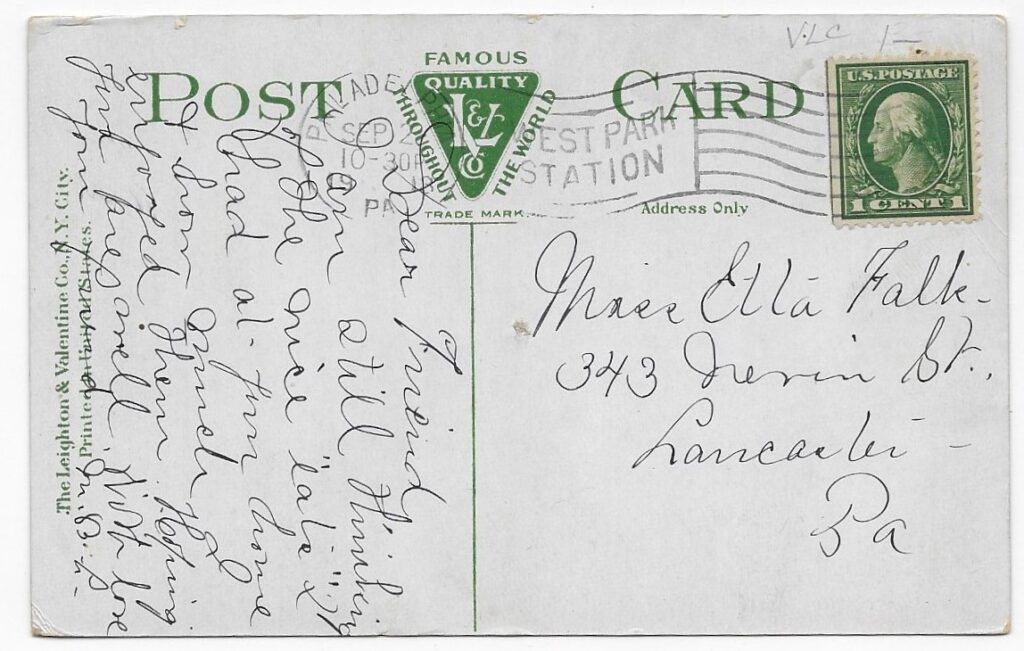
In September of 1913, Ella received a postcard from “M. B. L.” (possibly, Mr. B. L.).
The postcard was mailed from Philadelphia, about 65 miles to the east via the Lincoln Highway or the Pennsylvania Railroad.
https://en.wikipedia.org/wiki/Philadelphia
+ + + + + +
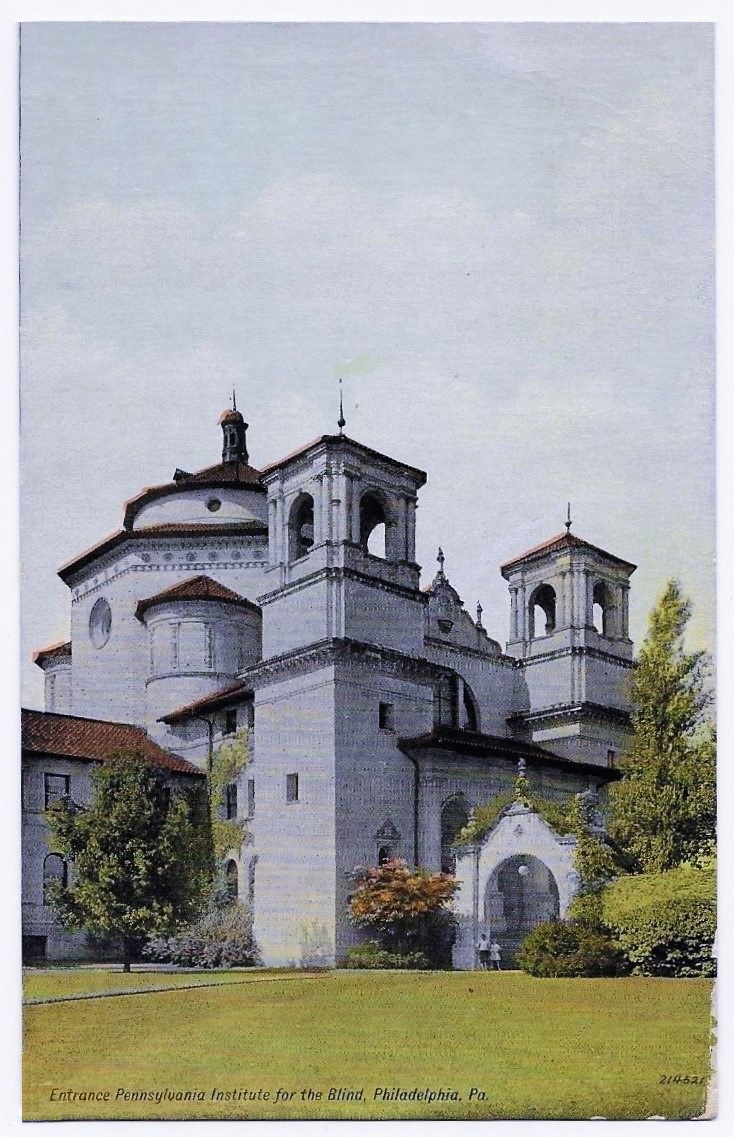
The face of the postcard is a photograph of the “Pennsylvania Institute for the Blind”.
This institution was founded in Philadelphia in 1832 when prominent citizens invited Julius Friedlander to organize a school for the blind.
Friedlander was a German scholar who had pioneered methods of instruction and book printing for blind students.
https://en.wikipedia.org/wiki/Julius_Reinhold_Friedlander
The first school was erected on the site of the current Franklin Institute, but a larger campus (part of which is featured in this postcard photograph) was created on Malvern Avenue in 1896.
https://www.obs.org/who-we-are/museum-and-history.cfm
The Pennsylvania Railroad constructed a special station access, and the Philadelphia trolley system served the school.
The achievements of this school, the students, and a succession of gifted headmasters, deserve a much longer treatment than this postcard story.
The campus was renamed the Overbrook School for the Blind in 1946.
https://en.wikipedia.org/wiki/Overbrook_School_for_the_Blind
The postcard was published by the “Leighton & Valentine Company” of New York, and was “Printed in the United States”.
This merger of two postcard firms into a US printing company was fortuitous – the eruption of the “Great War” in 1914 ended the transatlantic trade in postcards.
+ + + + + +
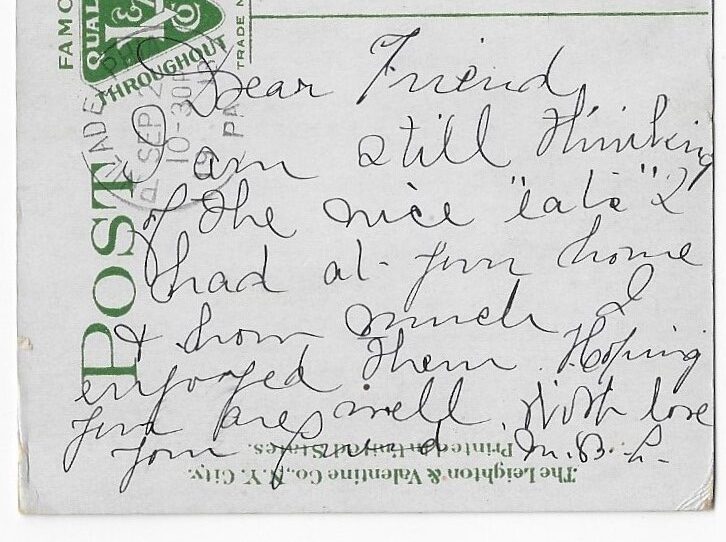
On the reverse, Ella is greeted as “Dear Friend”.
The writer reports “I am still thinking of the nice “eats” I had at your home and how much I enjoyed them.”
The friend adds, “hoping you are well”, and sends the message “with love”.
We cannot help but be curious about the memorable delicacies served by Ella; there is no indication of the specific food that elicited this encomium.
Ella preserved the postcard in good condition throughout her life.
One hopes that the friendship flourished and that more delicious meals were consumed together.’