This postcard was not addressed; there are no personalities attached to it.
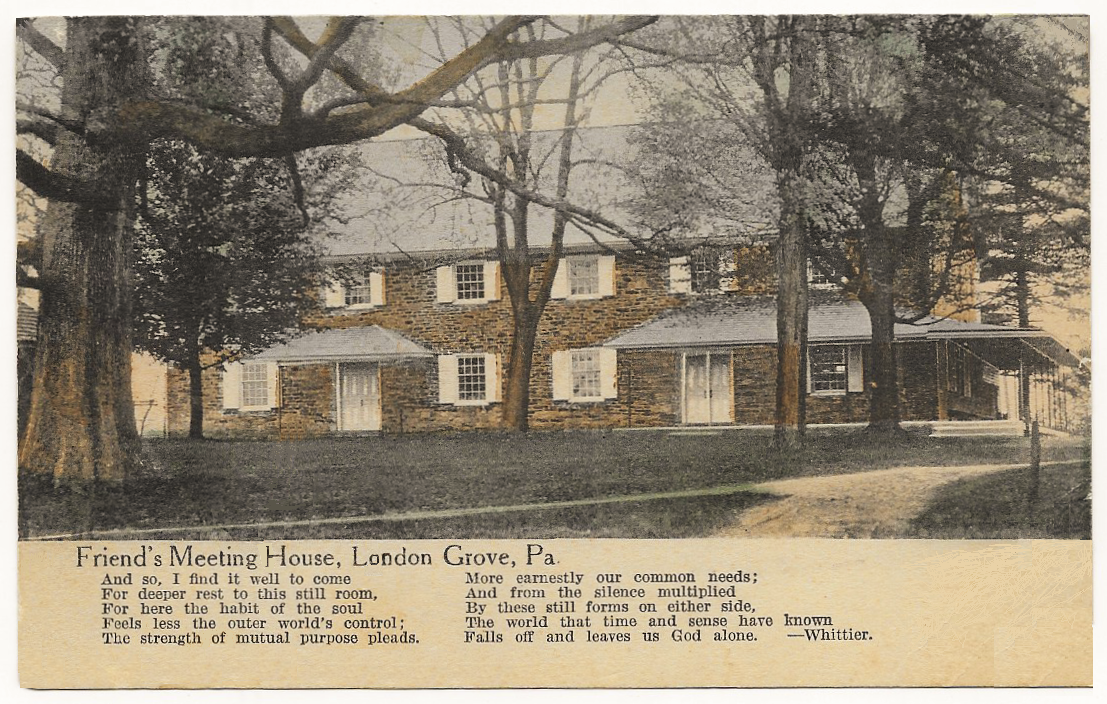
The face of the postcard is a photograph of the “Friend’s Meeting House, London Grove, PA”
“London Grove” was the name given to a region of southern Chester County in southeast Pennsylvania.
The first European settlers were English Quakers who received Land Grants from William Penn.
https://en.wikipedia.org/wiki/London_Grove,_Pennsylvania
Today, there is a small community called “London Grove”, and a “London Grove Township” in southern Chester County.
https://en.wikipedia.org/wiki/London_Grove_Township,_Pennsylvania
+ + + + + +
The London Grove Friends Meeting was formed in 1714; records of the first century of meetings are preserved at Bryn Mawr College – which was established as a Quaker college for women in 1885.
The early meetings were held in homes; the first meeting house (of stone and logs) was erected in 1724.
The building of local stone pictured on the postcard was erected in 1818; the larger size was intended to accommodate the Western Quarterly Meetings.
(I have no evidence for this, but I suspect that the postcard may relate to a centennial of the 1818 Meeting House.)
Today, London Grove Friends Meeting House is located within the boundaries of Kennett Square.
The Meeting continues to thrive – with a weekly meeting and the operation of a renowned kindergarten and other community projects.
+ + + + + +
Beneath the photograph, ten lines of poetry (attributed to John Greenleaf Whittier) are inscribed.
Whittier (1807-1892), was a poet whose work reflected his Quaker upbringing in New England.
He was known both for his popular poems (memorized by thousands of 19th century students) and for his writings in support of Abolition.
https://en.wikipedia.org/wiki/John_Greenleaf_Whittier
Few contemporary students know of Whittier’s “The Barefoot Boy”, “Maud Muller”, or “Barbara Frietchie”.
https://www.poetryfoundation.org/poems/45483/barbara-frietchie
Some may know Whittier’s poetic hymn, “Dear Lord and Father of Mankind”.
https://www.hymnsite.com/lyrics/umh358.sht
The postcard quotation is from a longer poem entitled “The Meeting”.
https://www.theatlantic.com/magazine/archive/1868/02/the-meeting/628428
The pairing of the Meeting House, and the poetic homage of a Quaker poet, is fitting and poignant.