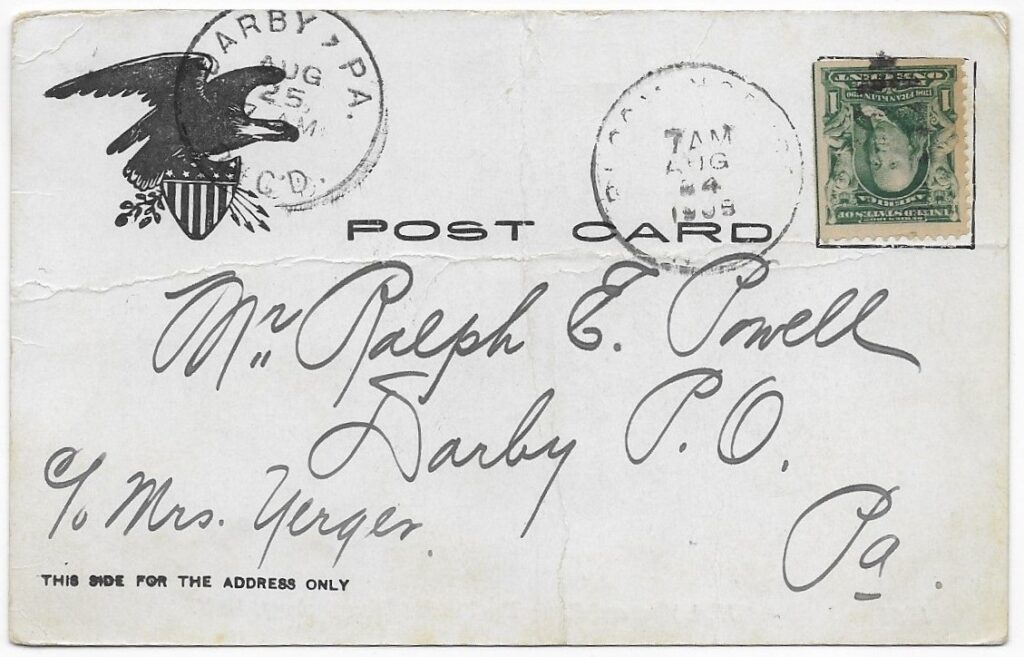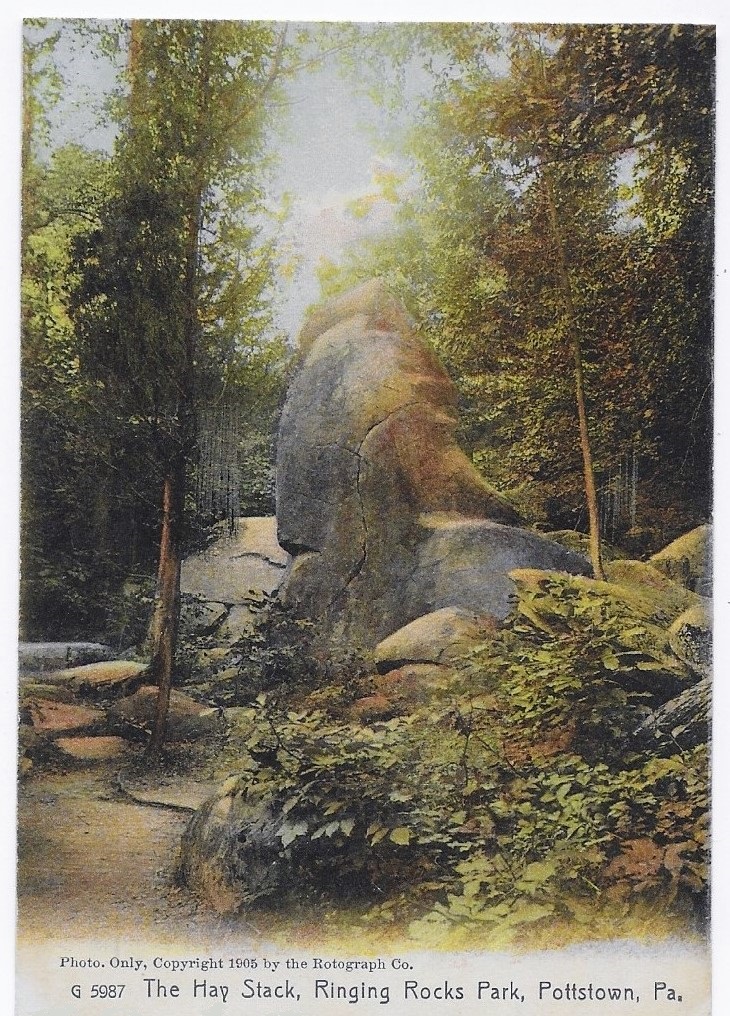
Mr. Ralph E. Powell resided in Darby, a borough (distinct from adjoining Darby Township) in Delaware County of southeast Pennsylvania.
This community along the Darby Creek, five miles southwest of center city Philadelphia, was first settled by Quaker families in 1682.
The settlement, led by John Blunston, espoused strong abolitionist and fair-trade principles.
https://en.wikipedia.org/wiki/Darby,_Pennsylvania
It appears that Mr. Powell might be living in rented rooms or a boarding house; he received his mail “In care of Mrs. Yerger”.
In August of 1905, Ralph received a postcard from an unidentified friend.
The postcard was mailed from Bloomingburg, a village (now within the town of Mamakating) in Sullivan County of southeast New York State.
During the last decades of the 19th century, the village was a railroad stop for summer vacationers to the mountains.
Many commercial guesthouses were never rebuilt after a devastating fire in 1922.
The community is now primarily agricultural.
https://en.wikipedia.org/wiki/Bloomingburg,_New_York
In the 21st century, the village was embroiled in a bitter dispute over election fraud related to the development of an Hasidic housing development in the village.
+ + + + + +
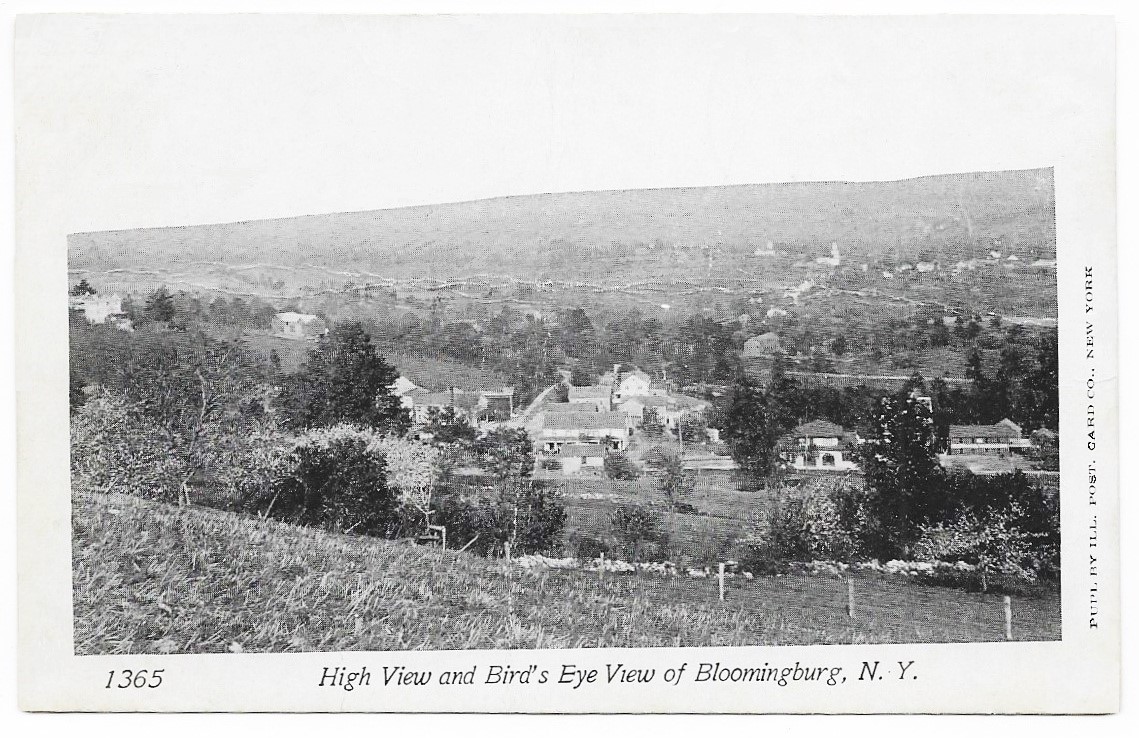
The face of the postcard is a photograph of a “High View and Bird’s-Eye View of Bloomingburg, N.Y.”
I do not believe that this is an aerial photograph – in another ten years, photos from aircraft became known as “bird’s-eye views” and were very popular.
By 1920, some early aviators subsidized their income by facilitating the taking aerial shots of populated areas.
https://airandspace.si.edu/stories/editorial/beginnings-and-basics-aerial-photography
Here, we see the village center with houses and farms scattered across a broad valley.
The postcard was published by the Illustrated Post Card Company of New York.
(One can observe that the printer slipped when centering the photo on the card stock.)
+ + + + + +
Because the postcard has an undivided back, there is no place for correspondence on the reverse.
The sender may have been reluctant to inscribe any words on the abundant margin of the face.
We trust that Ralph could identify the correspondent.
Although there were numerous errant ink stains on the face (probably from transit in the mail), Ralph preserved the postcard in good condition throughout his life.