Mrs. Victor Myers lived in Saratoga Springs, the resort city in Saratoga County of the Hudson River Valley about 35 miles north of Albany, New York.
Since the 18th century, visitors came to the area’s mineral springs in search of relief from a multitude of afflictions and complaints.
Numerous sanatoria and spas were in the area.
https://en.wikipedia.org/wiki/Saratoga_Spa_State_Park
A Gilded Age resort developed around horse racing and summer sports on Lake Saratoga in the last half of the 19th century.
https://en.wikipedia.org/wiki/Saratoga_Springs,_New_York
(Viewers of the TV serial “The Gilded Age” may recall how “new money” mansions in Newport, Rhode Island disturbed the peace of the wealthy habitues of Saratoga Springs.)
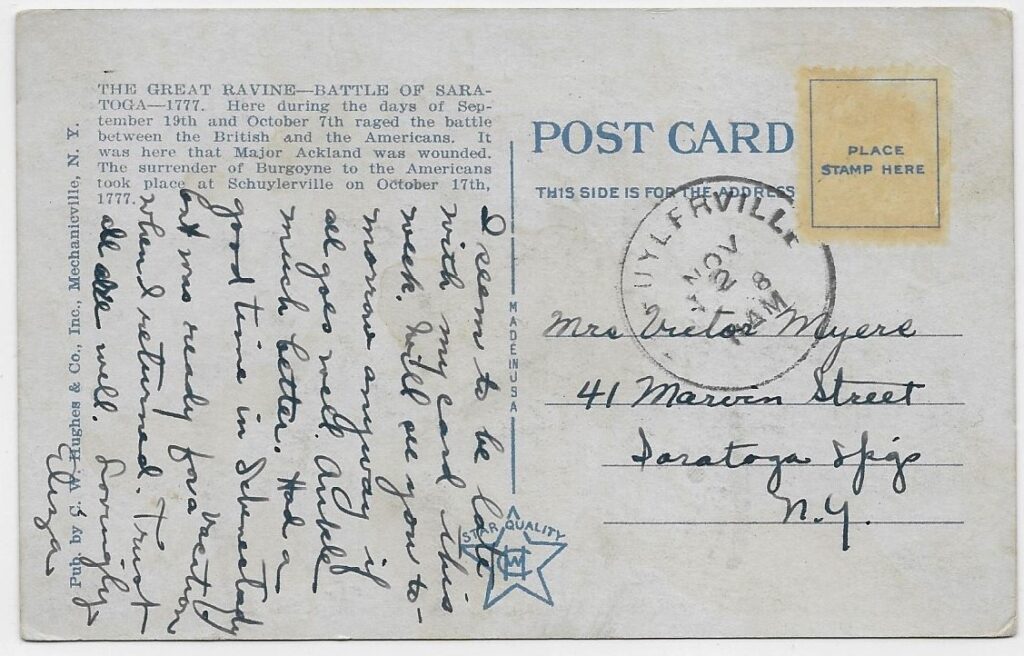
In November of a year near 1920, Mrs. Myers received a postcard from Eliza.
Eliza mailed the postcard from Schuylerville, an historic village east of Saratoga Springs.
This community was the original civilian settlement when the British Fort Saratoga was erected in what is now Saratoga Springs.
https://en.wikipedia.org/wiki/Schuylerville,_New_York
Named for the Schuyler family, a prominent Dutch family in early European settlement of the Hudson Valley, Schuylerville was the site of the formal surrender of General Burgoyne after the Revolutionary Battle of Saratoga.
https://en.wikipedia.org/wiki/Schuyler_family
+ + + + + +
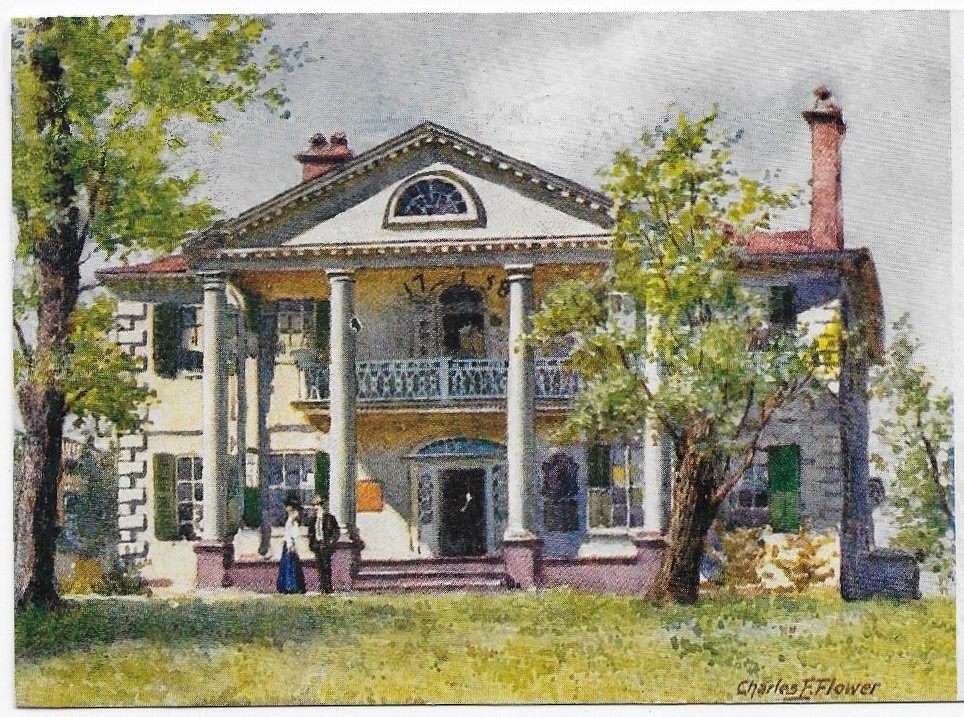
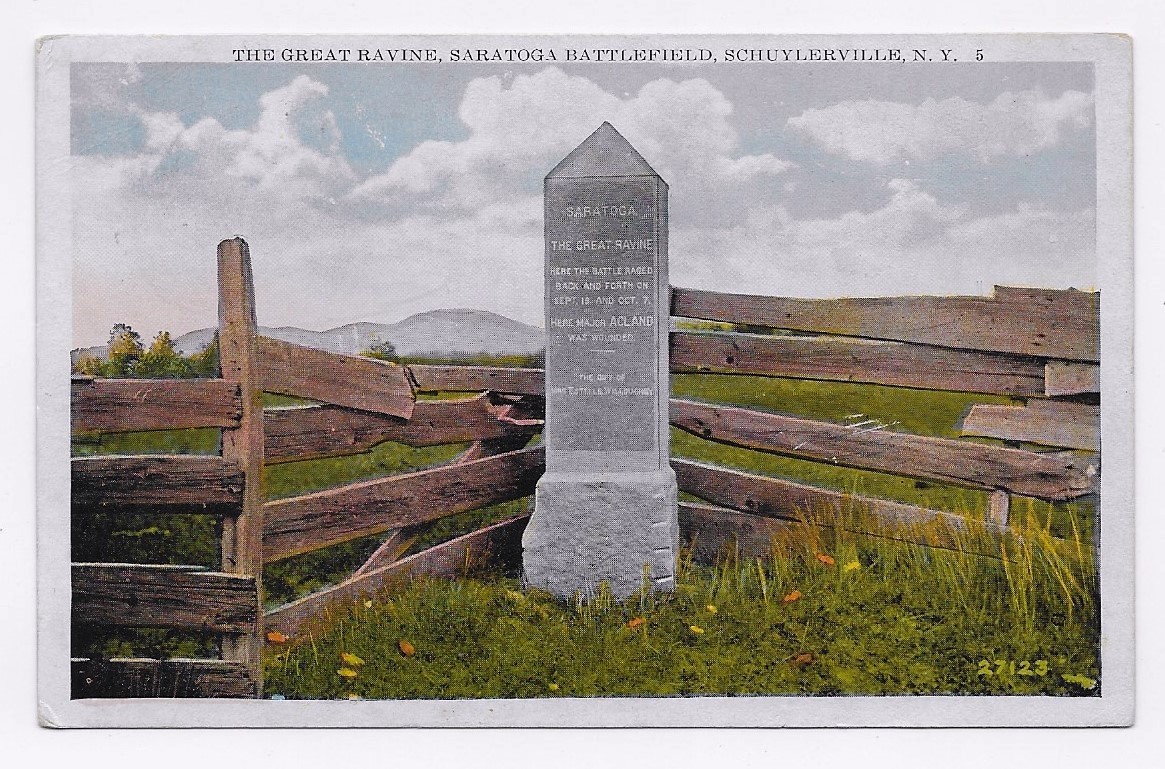
The face of the postcard is a photograph of “The Great Ravine” of the “Saratoga Battlefield” at “Schuylerville, N.Y.”
A blurb on the reverse describes the series of engagements (September and October of 1777) in which a Continental Army under Horatio Gates defeated the large British land army of General Burgoyne.
In this campaign, British General John Burgoyne led an army south from Canada to cut off New England from the rest of the colonies by taking control of the Hudson River.
https://en.wikipedia.org/wiki/Battles_of_Saratoga
The treason of Benedict Arnold, a plot to surrender West Point, was a part of this plan.
The victory at Saratoga was the turning point of the Revolution, and, had it failed, might have doomed the American war effort.
The postcard photograph was published by C. W. Hughes & Co. of Mechanicville, N.Y.
+ + + + + +
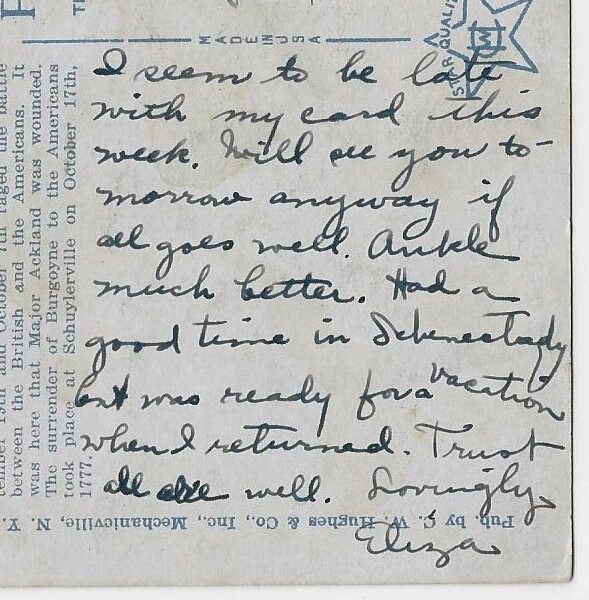
On the reverse, Eliza begins without a greeting: “I seem to be late with my card this week.”
Fortunately, the friends will soon reunite: “Will see you tomorrow anyway if all goes well.”
Eliza then refers to some prior injury, writing “Ankle much better.”
It appears that Eliza may have concluded a short vacation or holiday jaunt – she reports “Had a good time in Schenectady but was ready for a vacation when I returned.”
The message concludes with a wish, “Trust all are well” and with “Lovingly, Eliza”.
Mrs. Myers preserved the historic scene in good condition throughout her life.
One hopes that she and Eliza maintained a postcard correspondence for many years.