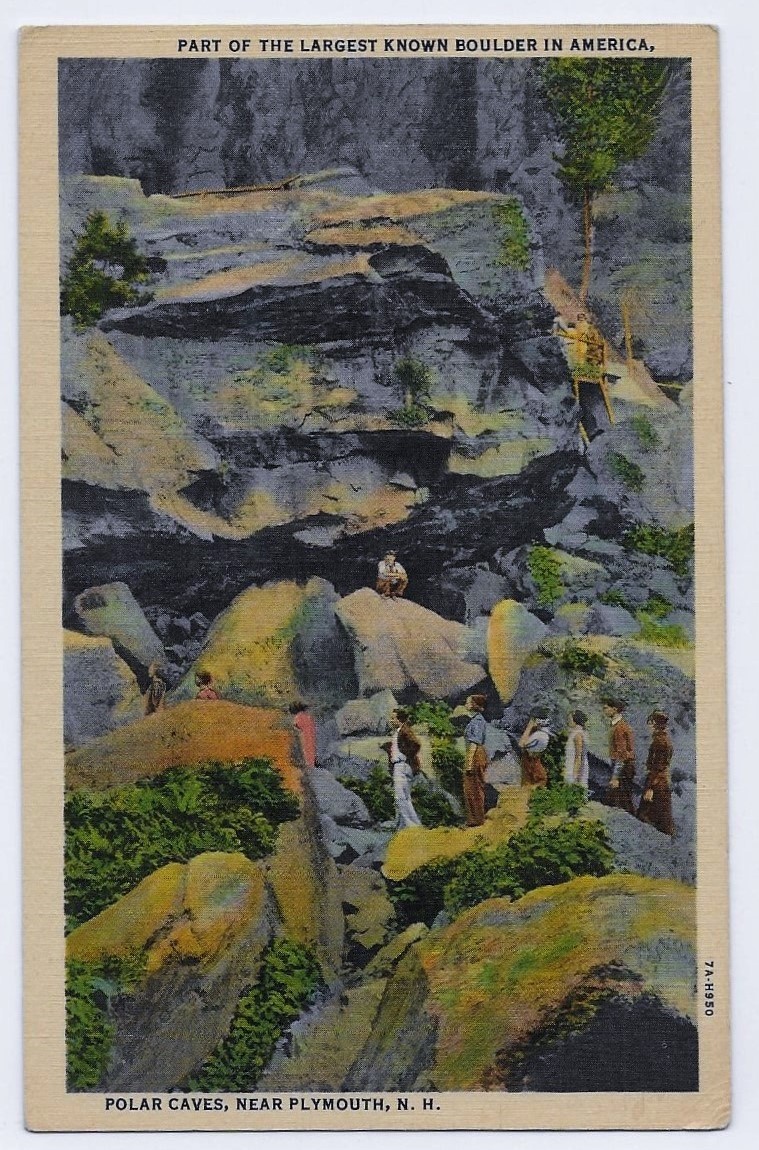
This postcard was not mailed, so there are no personalities attached to it.
The face of the postcard shows a very large boulder poised below a steep cliff face.
A group of visitors stand amid smaller stones at the base of the cliff.
Perched atop the boulder, a young man, perhaps a guide, appears to be providing some information about the rocky formation.
The printed title identifies this as “Part of the Largest Known Boulder in America”.
Beneath the linen-style image, a legend announces, “Polar Caves, near Plymouth, N. H.”
Plymouth, a town in Grafton County of west-central New Hampshire, was founded at the junction of the Pemigewasset River and the Baker River.
https://en.wikipedia.org/wiki/Pemigewasset_River
Nestled at the foot of the White Mountains, Plymouth was settled soon after the French and Indian War by immigrants from other parts of New England – many of whom were former soldiers who were given land there.
The center of higher education, medicine, and culture in this rural region, Plymouth today has a population of about 6700 residents – half of whom are students at Plymouth State University.
https://en.wikipedia.org/wiki/Plymouth,_New_Hampshire
Fun Facts:
Daniel Webster lost his first criminal court case at the Plymouth Courthouse in 1806.
Nathaniel Hawthorne died in Plymouth while on vacation with his college friend, former President Franklin Pierce, in 1864.
+ + + + + +
The “Polar Caves” near Plymouth are an example of “talus caves” -those formed from the gaps between fallen boulders.
They are found in many kinds of rock throughout New England where ancient glaciation left sheer rock faces that experience repeated freezing and thawing.
Granite, Schist, and other “highly competent” rock is more likely to fracture into large “blocks” that create talus caves.
https://en.wikipedia.org/wiki/Talus_cave
The Polar Caves were discovered in 1922 by a student at the Plymouth High School and the site was rapidly developed as a tourist attraction by local leaders who created trails and hired guides.
Today, these granite formations can be explored within Polar Caves Park which is open from May to October.
https://en.wikipedia.org/wiki/Polar_Caves_Park
This postcard was published by the Curt Teich Company of Chicago, and may be a souvenir which was collected by a visitor to the Polar Caves in the 1930’s.