I confess that I was barely aware the life and deeds of James Smith although he was a Pennsylvania Delegate to the Continental Congress and a signer of the Declaration of Independence.
https://en.wikipedia.org/wiki/James_Smith_(Pennsylvania_politician)
James Smith was born in Ireland in 1719, his family immigrated to Chester County Pa when James was 10 years old.
https://en.wikipedia.org/wiki/Chester_County,_Pennsylvania
James was a student of Francis Allison of the Newark Academy (University of Delaware) and a graduate of the Pennsylvania Academy (University of Pennsylvania).
After his admission to the Bar, Smith served as a lawyer in Shippensburg, PA then in York, PA.
https://en.wikipedia.org/wiki/Shippensburg,_Pennsylvania
He became a captain of militia in York and was appointed to the Provincial Convention of 1775, and then elected as a delegate to the Continental Congress.
https://en.wikipedia.org/wiki/Continental_Congress
+ + + + + +
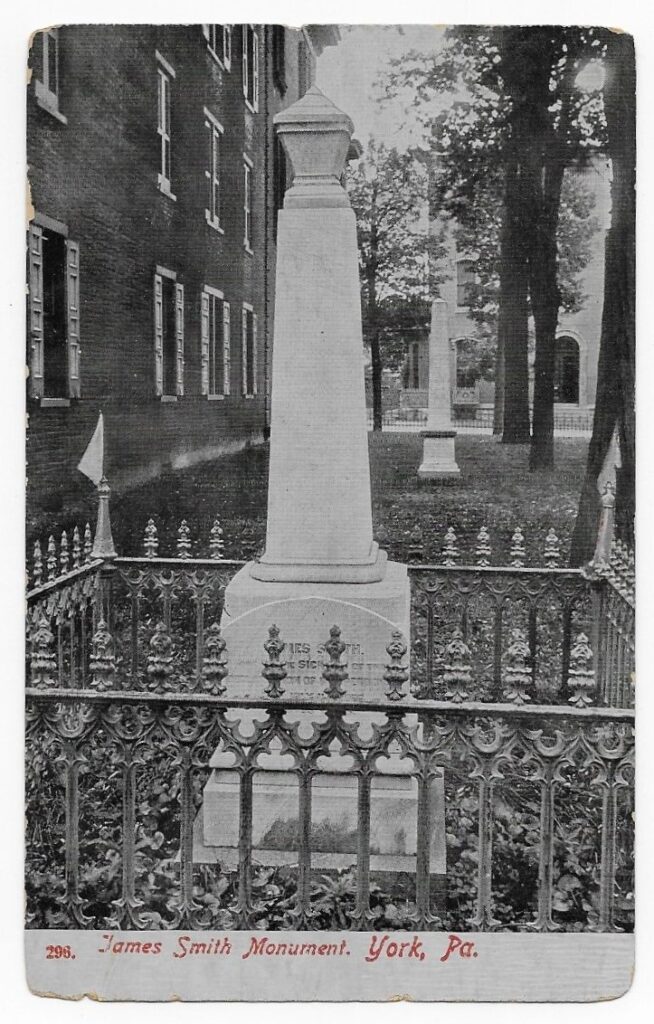
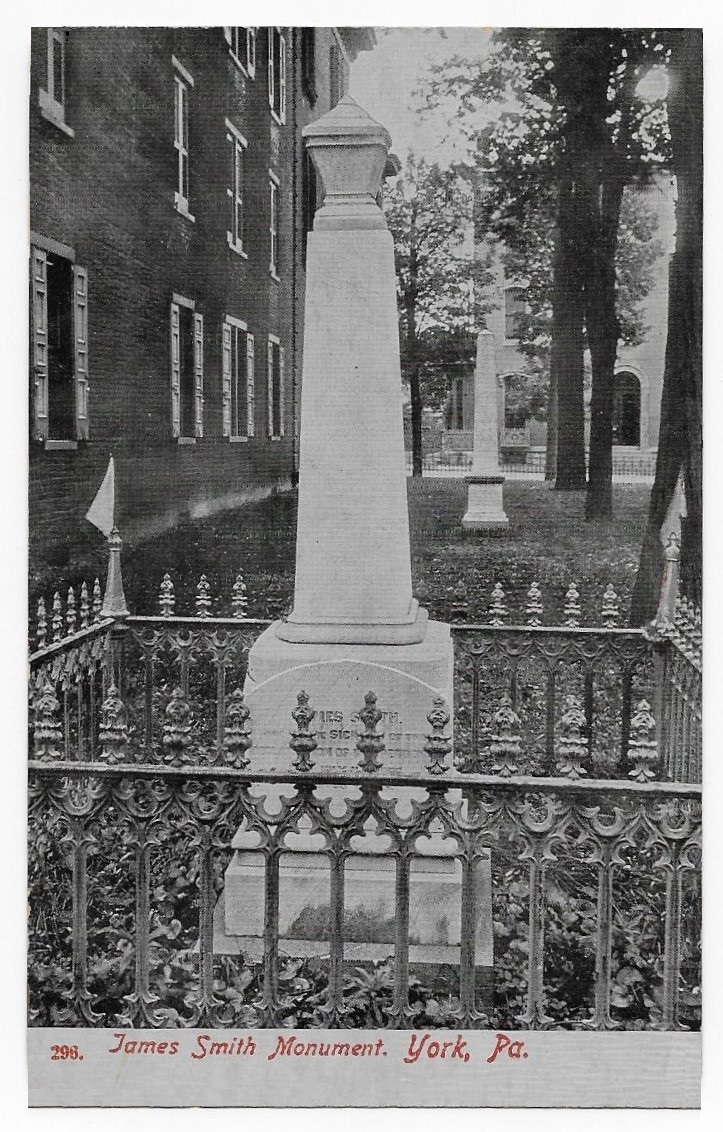
The face of the postcard is an uncolored photograph of the “James Smith Monument”.
The postcard title identifies “York, PA”, but does not offer a more precise location of the memorial.
https://en.wikipedia.org/wiki/York,_Pennsylvania
An informative article by a blog post associated to the York County History Center provides remarkable context.
Here, we learn that the stone marker was erected over the grave of James Smith in the churchyard of the First Presbyterian Church in York.
https://www.fpcyork.org/history
This monument was carved by a local stonemason, Emanuel King, about 1850 – and it replaced an earlier, less distinguished, marker.
+ + + + + +
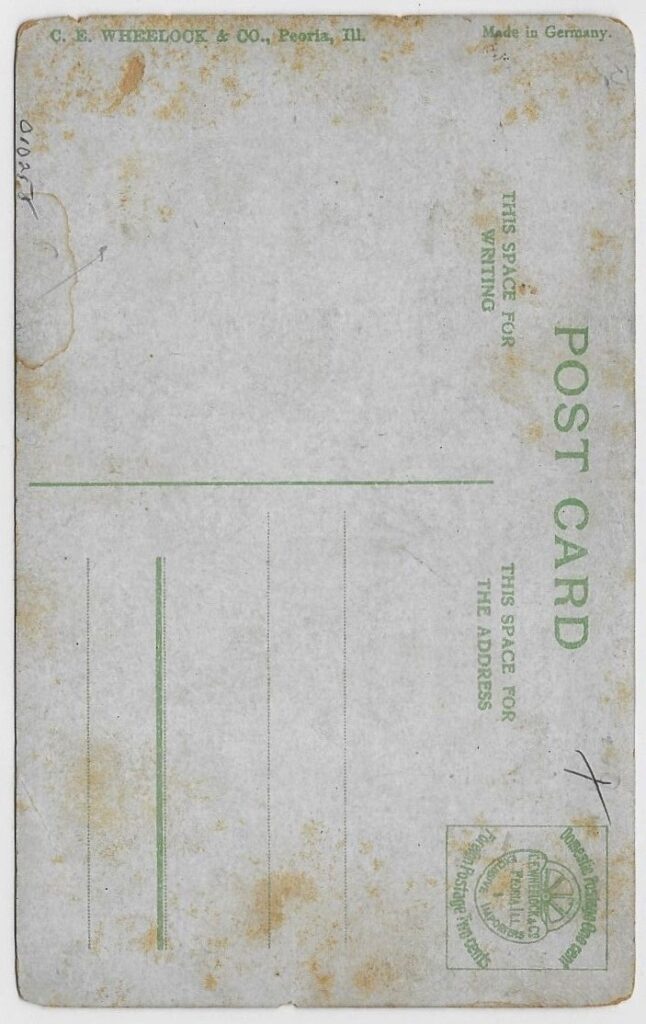
The postcard photograph was published by C. E. Wheelock & Company of Peoria, Illinois.
Charles Wheelock was born into a successful family of merchants.
Eventually Charles struck out on his own in Peoria, Illinois and there created an enormous business importing German and Austrian china and porcelain to which he affixed scenes of local landmarks and natural wonders.
https://www.steinmarks.co.uk/page?id=295
As a sideline to the business of images, the C. E. Wheelock Company began printing postcards as postcard collecting became a craze in the first decade of the 20th century.
The postcard was printed in Germany.
+ + + + + +
This postcard was not mailed, and has no personal stories attached to it.
One imagines that the postcard was collected for its relevance to national or local history.