The example of Roscoe Conkling may remind us how the passage of time shows the impermanence of fame and political influence.
Roscoe Conkling (1829-1888) was an American lawyer and Republican politician who represented New York in the United States House of Representatives and the United States Senate. He was a leader of the Republican Stalwart faction and a dominant figure in the United States Senate during the 1870s.
Born in Albany NY into a family related to and acquainted with New England Whig aristocracy, Conkling was a tall and robust man, endowed with handsome features and a remarkable gift for oratory.
https://en.wikipedia.org/wiki/Whig_Party_(United_States)
He is honored today for his outspoken support of the abolition of slavery, for his loyalty and political service to Abraham Lincoln, and for his key role in winning adoption of the 14th Amendment to the Constitution.
https://en.wikipedia.org/wiki/Roscoe_Conkling
He is less favorably remembered for the fortune he made in selling cotton to the Union Army during the Civil War and for his life-long resistance to the Civil Service – protecting the corrupt process of Senatorial privilege in making government appointments.
From Google:
“Senator Roscoe Conkling fiercely led the “Stalwarts,” a Republican faction that defended the “spoils system” and vehemently opposed civil service reform.“
+ + + + + +
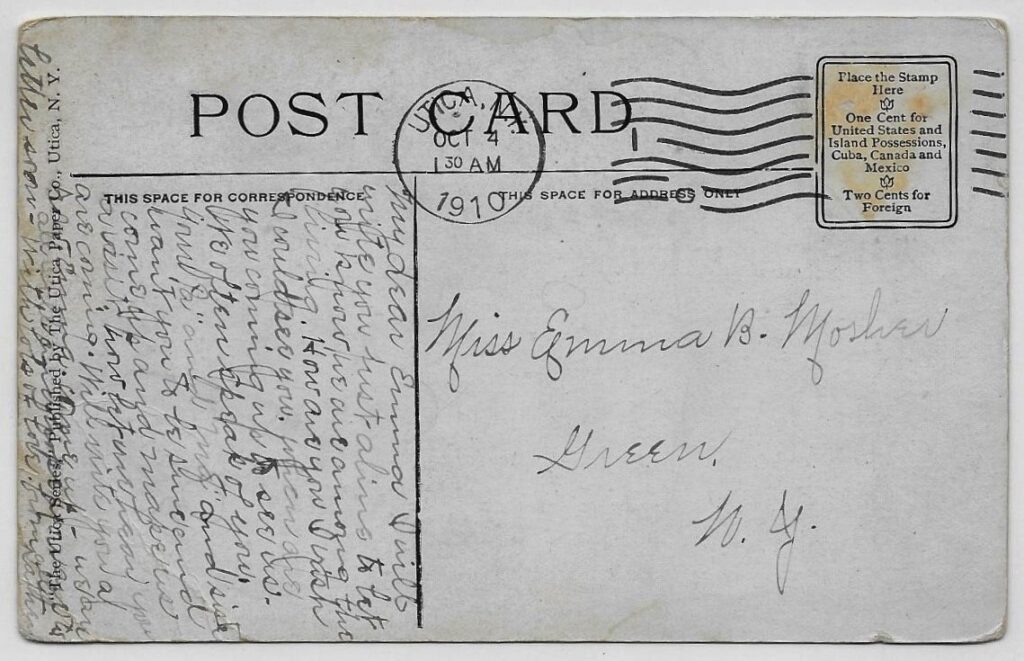
Miss Emma B. Mosher lived in Greene, a village and a town in Chenango County of central New York.
In the 19th century, the Chenango Canal connected the area to the Erie Canal at Utica, NY – about 70 miles to the north.
https://en.wikipedia.org/wiki/Greene,_New_York
In October of 1910, Emma received a postcard from a friend or family member (possibly, her sister).
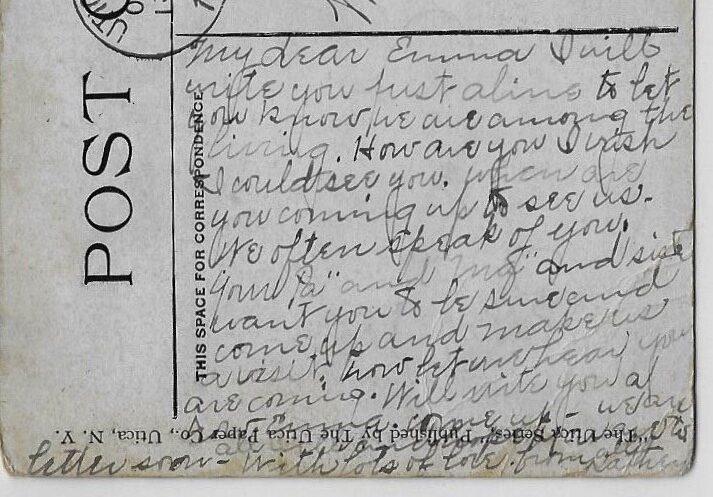
The name is difficult to decipher; the edge of the postcard is damaged where the writer has squeezed words and lines together.
The postcard was mailed from Utica, which had become a prosperous city of industry, shipping, and transportation on the Erie Canal – later, the New York Central Railroad.
https://en.wikipedia.org/wiki/Utica,_New_York
Some time ago, we saw a postcard photograph of the city of Utica:
+ + + + + +
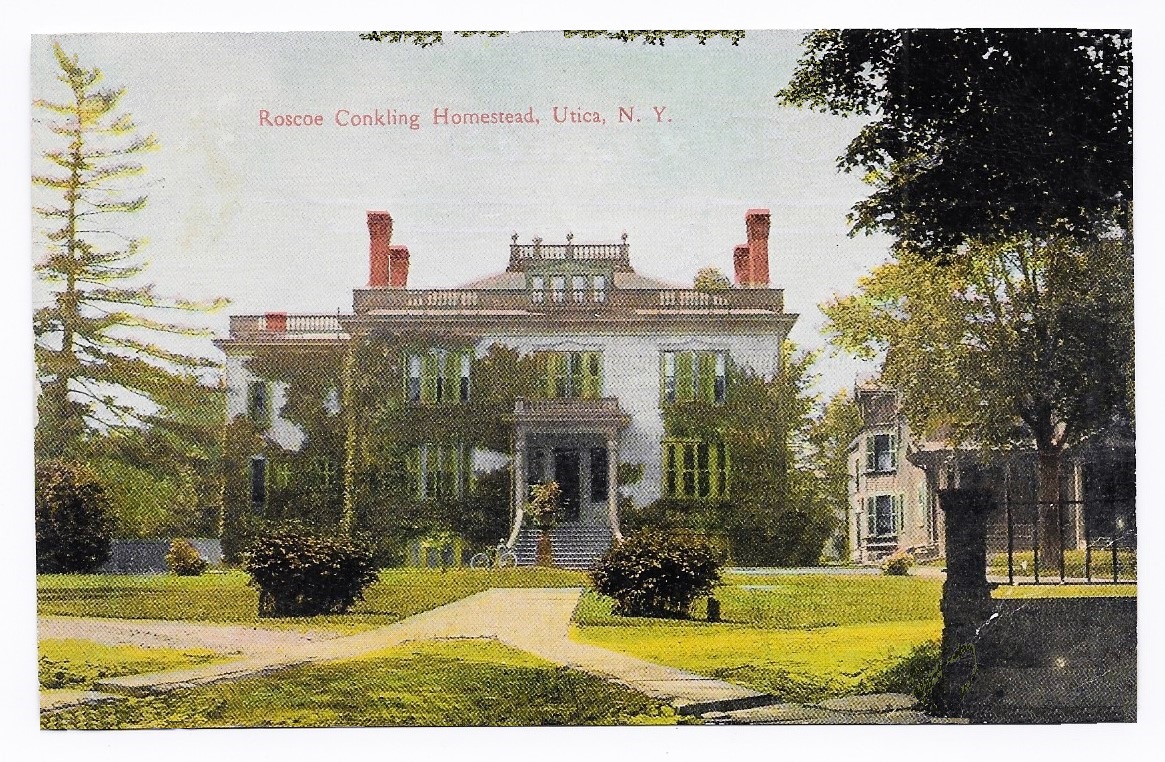
The face of the postcard is a photograph of the “Roscoe Conkling Homestead, Utica, N.Y.”
Conkling lived in Utica during his terms in the US Congress, and maintained his law office there.
The Conkling House was built (originally, for another family) in the Greek Revival style according to the design of Philip Hooker in the 1820’s.
https://en.wikipedia.org/wiki/Roscoe_Conkling_House
Today, the House has State and National Landmark Status and is preserved within an Historic District – the structure is owned by the Landmark Society of Greater Utica,
The House is gradually being renovated as a museum =- but Utica is not as prosperous as it was in the early 20th century.
+ + + + + +
On the reverse, the writer greets, “My Dear Emma”.
Apparently, Emma and the writer have not communicated recently; the writer sends “a line to let you know we are among the living.”
The writer asks “How are You” and expresses a “wish I could see you.”
Emma is asked, “When are you coming up to visit”.
The household in Utica, “your Ma and Pa and your sister”, all “speak of you often” and “want you to come visit”.
There are further comments related to a visit, but I have not untangled them.
Emma preserved the postcard in decent condition throughout her life.
One hopes that Emma made a visit to her family members and friends in Utica, and that the correspondents exchanged many more postcards.