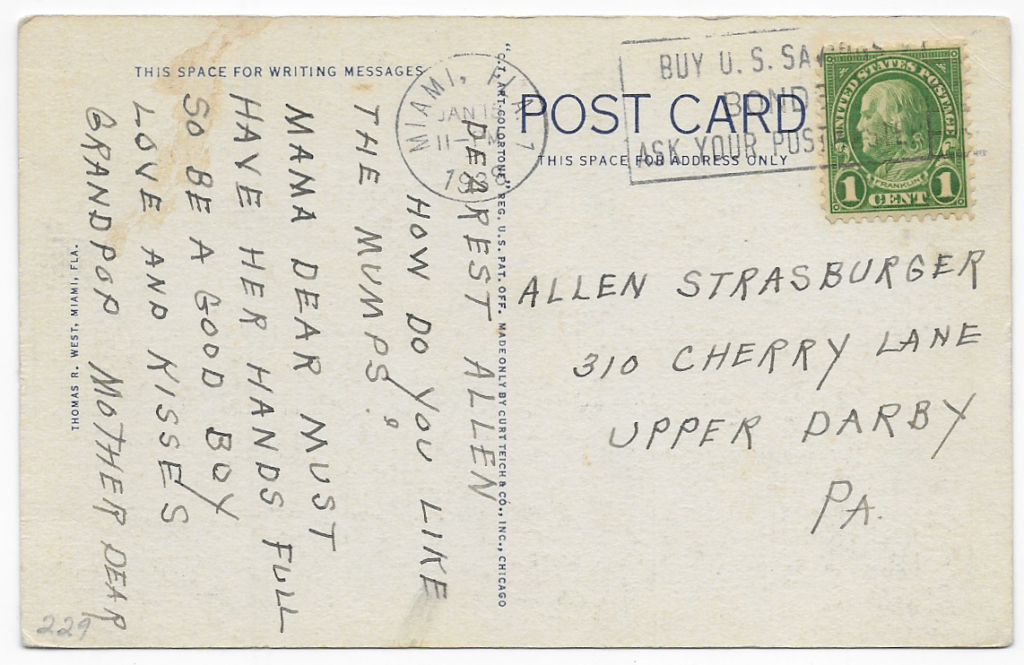
Allen Strasburger was growing up in Upper Darby, a self-governing township that lies within a patchwork of municipalities on the edge of Philadelphia in southeast Pennsylvania.
The first European settlers in this area were Swedish immigrants to the colony of “New Sweden”.
The arrival of English Quakers led to Upper Darby becoming a hotbed of anti-slavery agitation.
https://en.wikipedia.org/wiki/Upper_Darby_Township,_Pennsylvania
In January of 1938, Allen had the mumps.
https://my.clevelandclinic.org/health/diseases/15007-mumps
To cheer him up, he received a postcard from “GrandPop”.
The postcard was mailed from Miami, the city in southeast Florida and a center of commerce, finance, culture, and international trade.
https://en.wikipedia.org/wiki/Miami
Since the early 20th century, Miami has seen a booming tourism industry.
https://en.wikipedia.org/wiki/History_of_Miami
+ + + + + +
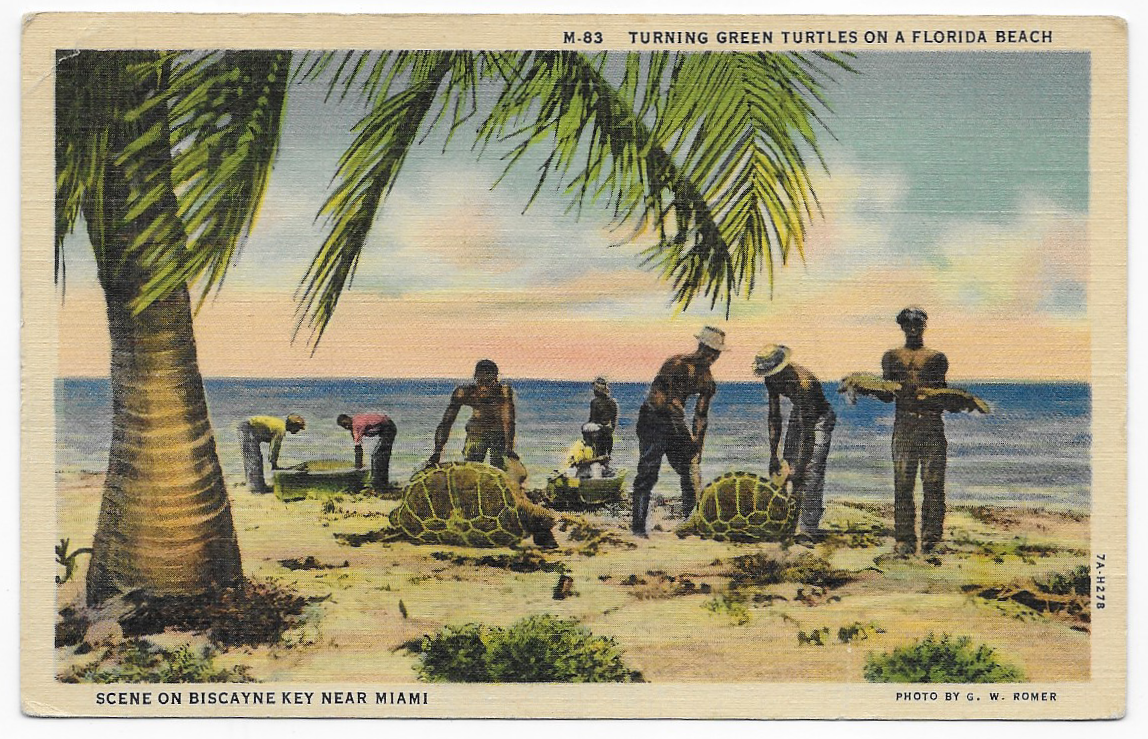
The face of the linen-style postcard is a photograph of workers on the beach at Biscayne Key.
Key Biscayne is the southernmost barrier island on the east coast, lying between the Atlantic and Biscayne Bay – south of Miami Beach.
https://en.wikipedia.org/wiki/Key_Biscayne
Here, the workers are “Turning Green Turtles on a Florida Beach”.
Green Turtles are so named because of a green layer of fat beneath their dark shells.
The green color is due to the sea turtle’s exclusive diet of sea grass.
Sea turtles may migrate very long distances between their feeding grounds and the islands where they typically lay their eggs.
https://en.wikipedia.org/wiki/Green_sea_turtle
Sea Turtles on land are extremely vulnerable to tidal shifts, uneven ground, or slippage that can lead to their death if they are overturned.
From Google:
“Overturned green sea turtles can become stuck on land after nesting or face physical danger if flipped upside down by rough surf or obstacles.
Nesting Stranding: Female green sea turtles sometimes flip onto their backs or get wedged between rocks or steep dunes after crawling ashore to lay eggs.
Unlike some land tortoises, adult sea turtles are heavy and streamlined for water. If trapped upside down on dry sand or rocks, they struggle to flip back over.
An overturned turtle on a beach is vulnerable to extreme heat, dehydration, and predators if not helped quickly.”
Here, beach rescue teams save the overturned turtles by turning them to their feet.
The postcard was first published by Thomas R. West of Miami; the coloration was done according to the patented “Colortone” process of the Curt Teich Company of Chicago.
+ + + + + +
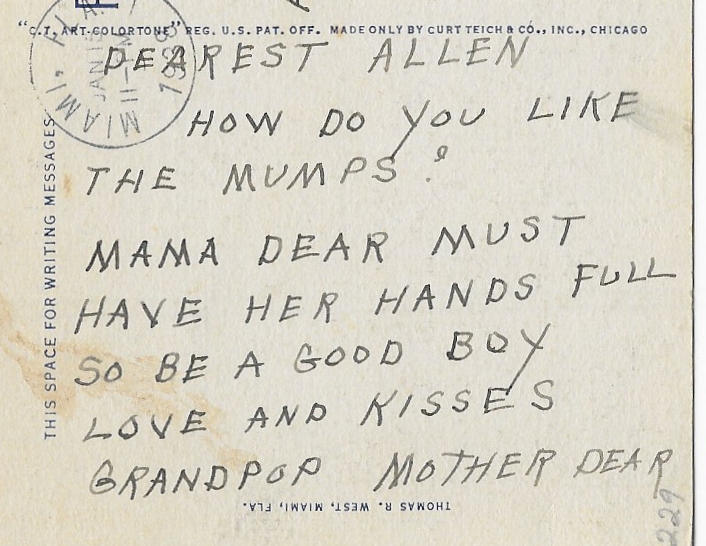
On the reverse, Grandpop greets, “Dearest Allen” and asks, “How do you like the mumps”.
Recognizing that “Mama Dear must have her hands full”, Grandpop reminds Allen to “be a good boy”
The message closes with “love and kisses”.
The postcard was preserved in very good condition.
One hopes that Allen recovered quickly from the mumps, that Mother was not unduly taxed, and that Grandpop sent many more postcards.