Among the historical figures who have been safely swaddled in casual generalizations is the fiery abolitionist, John Brown.
Most Americans today, if they think of him at all, have inherited the belief that Brown’s revolutionary zeal led only to his own demise and to hastening the Civil War.
It is much harder to reckon with Brown’s absolute conviction that some evils require that persons of good conscience must resist them immediately and completely.
+ + + + + +
John Brown (1800-1859) was born in Torrington, Connecticut to parents who were children of soldiers in the American Revolution.
https://en.wikipedia.org/wiki/John_Brown_(abolitionist)
The family shares characteristics of many in their generation – they moved to Ohio, then a rugged frontier, and prospered in a variety of occupations.
John Brown became an ardent abolitionist in his youth, he once witnessed a slave boy beaten with a shovel.
But the essence of his character was religious.
From the Wiki:
An evangelical Christian of strong religious convictions, Brown was profoundly influenced by the Puritan faith of his upbringing.
He believed that he was “an instrument of God”, raised to strike the “death blow” to slavery in the United States, a “sacred obligation”.
+ + + + + +
The postcard story is too slight a format to discuss the popular currents and personalities that contributed to this singular character – love of books, knowledge of the New Testament, relation to Oberlin College, family connections to Ulysses Grant, businessman and postmaster in Pennsylvania, militia leader in defending free-state citizens in “Bloody Kansas”, friend of Frederick Douglas, etc.
In 1859, John Brown led a group of nineteen men who successfully seized the Armory (both an arms manufacturing site and a storehouse) in Harpers Ferry – a strategic town at the confluence of the Potomac and Shenandoah Rivers in what was then north-central Virginia.
https://en.wikipedia.org/wiki/Harpers_Ferry,_West_Virginia
The mission was, as Frederick Douglas had warned Brown, “suicidal” – and most of the raiders who took refuge in an engine house and withstood several assaults by Virginia troops were killed or captured (although five escaped).
https://en.wikipedia.org/wiki/John_Brown%27s_raid_on_Harpers_Ferry
On December 2, 1859, John Brown was hanged in Harpers Ferry after a conviction of treason against the Commonwealth of Virginia, inciting insurrection of slaves, and the murder of Virginia soldiers.
https://en.wikipedia.org/wiki/Trial_of_John_Brown
+ + + + + +
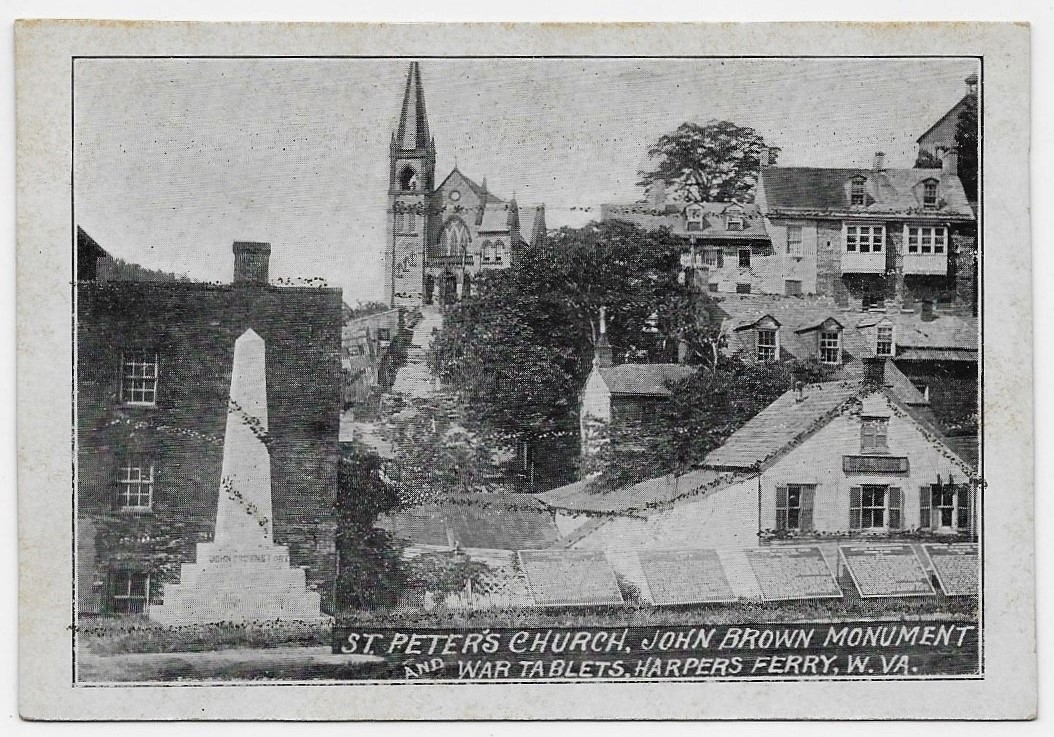
The face of this postcard is a photograph of “St. Peter’s Church, John Brown Monument, and War Tablets” in the town of Harpers Ferry, West Virginia.
St. Peter’s Church is a Roman Catholic parish founded in 1833 to serve Irish immigrants working on the Chesapeake & Ohio Canal and the Baltimore & Ohio Railroad.
Occupying a prominent site on the heights above the town, St. Peter’s was the only church to escape destruction in the military struggles to hold Harpers Ferry during the Civil War.
https://en.wikipedia.org/wiki/St._Peter%27s_Roman_Catholic_Church_(Harpers_Ferry,_West_Virginia)
The postcard shows the building after it was enlarged and refashioned in the Neo-Gothic style in 1896.
The War Tablets are a series of historic iron markers in and around Harpers Ferry to document pivotal Civil War military operations and the Confederate capture of the area in 1862.
https://www.nps.gov/places/000/capture-of-harpers-ferry-war-department-tablets.htm
The tablets were erected in 1897 by the Antietam Battlefield Board under the U.S. War Department.
+ + + + + +
In the courtroom, the wounded John Brown lay on a cot and was forbidden to speak,
But the trial attracted hundreds of journalists and artists and every aspect of the trial was magnified in daily dispatches.
Brown wrote several hundred letters which were widely published, and northern audiences were transfixed by his calm sacrifice for the extinction of slavery.
At his sentencing, the composed and serene John Brown offered an eloquent and unflinching testimony to the rightness of his actions.
https://en.wikipedia.org/wiki/John_Brown%27s_last_speech
His death galvanized abolitionist sentiment in the way that martyrdom does – throughout the North, opposition to slavery hardened enormously.
Hundreds of thousands of volunteers to the Union Army sang (in various iterations) “John Brown’s Body” – the song became an amalgamation of popular additions and amendments consistent with the camp-meeting traditions in which the tune originated.
https://en.wikipedia.org/wiki/John_Brown%27s_Body
“His truth goes marching on” took root in a way that was inconceivable before John Brown’s death.
The ragged lyrics (look them up!) were edited by various high-minded publishers and versifiers until the celebrated version of Julia Ward Howe became the “Battle Hymn of the Republic”.
https://en.wikipedia.org/wiki/Battle_Hymn_of_the_Republic
In that anthem, Truth, Justice, the destruction of wickedness, and the liberation of captives, is the work of God – although the echo of fiery John Brown is still heard.