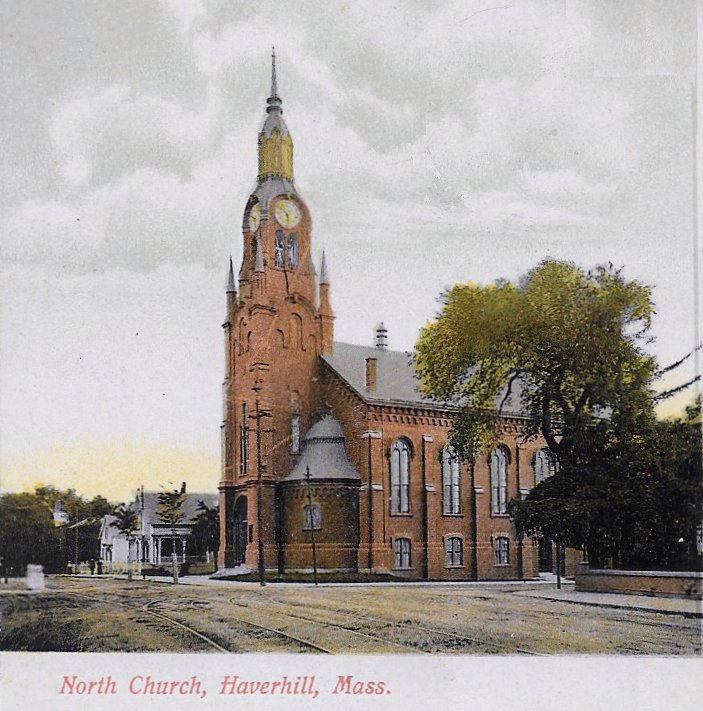
Mrs. Sarah McEwen resided in New Milford, a town on the Housatonic River in Litchfield County of northwest Connecticut.
https://en.wikipedia.org/wiki/New_Milford,_Connecticut
This area, fifty miles west of Hartford, and 80 miles north of midtown Manhattan, was first inhabited by Anglo-American settlers (from Westfield, Massachusetts) in 1707.
Today, the prosperous town is renowned for historic preservation and sizable wildlife preserves.
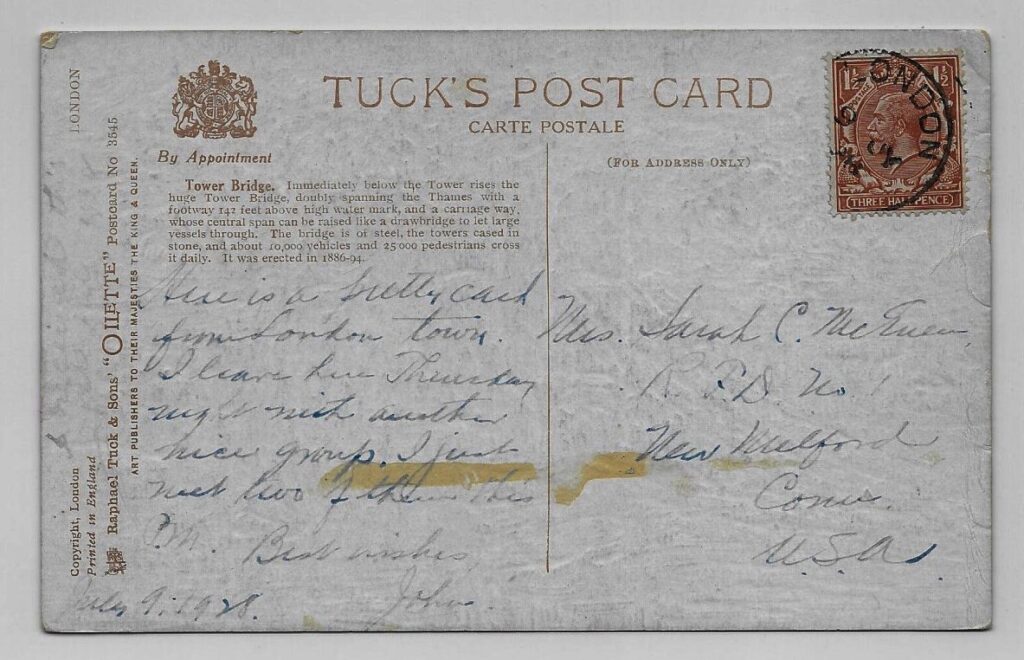
In July of 1928, Mrs. McEwen received a postcard from John.
The postcard was mailed from London, at the cost of three halfpence.
https://en.wikipedia.org/wiki/London
The postcard received some rough handling – it appears that the reverse was damaged by moisture and is overlaid with faint writing from another source.
https://en.wikipedia.org/wiki/Halfpenny_(British_pre-decimal_coin)
Fortunately, John displayed the marks of a good correspondent – inscribing the date of his writing at the end of the message.
The late 1920’s, before the Stock Market Crash, saw many Americans embark for European adventure.
From Google:
“Americans in Europe during the 1920s formed a diverse wave of tourists, business leaders, and expatriate artists drawn overseas by post-World War I exchange rates, cultural freedom, and economic expansion…”
+ + + + + +
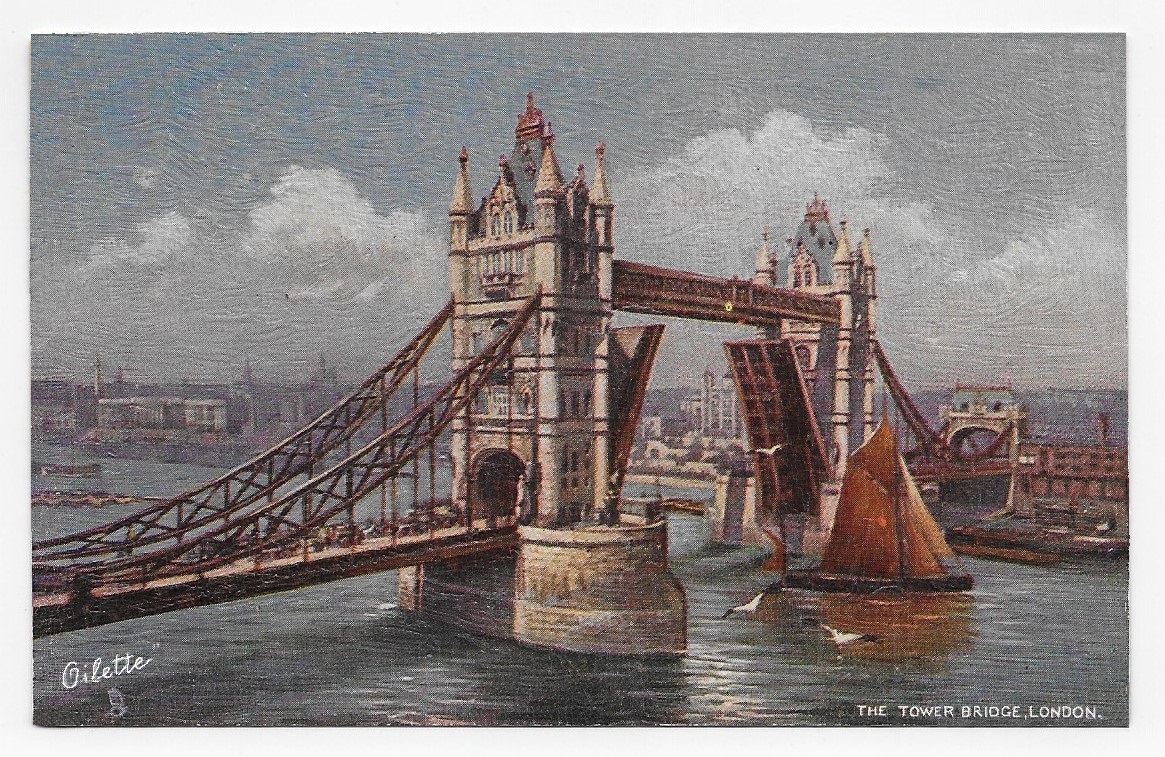
The face of the postcard is a depiction of Tower Bridge, the massive structure that traverses the Thames just below the Tower of London.
Due to the enormous number of ships on the Thames, planning for the bridge consumed years of deliberation and design.
The Wiki article describes in detail the laying of the stone piers in the river bottom, the massive amounts of steel shipped from English mills, and the complicated hydraulic system that preserved ship traffic.
https://en.wikipedia.org/wiki/Tower_Bridge
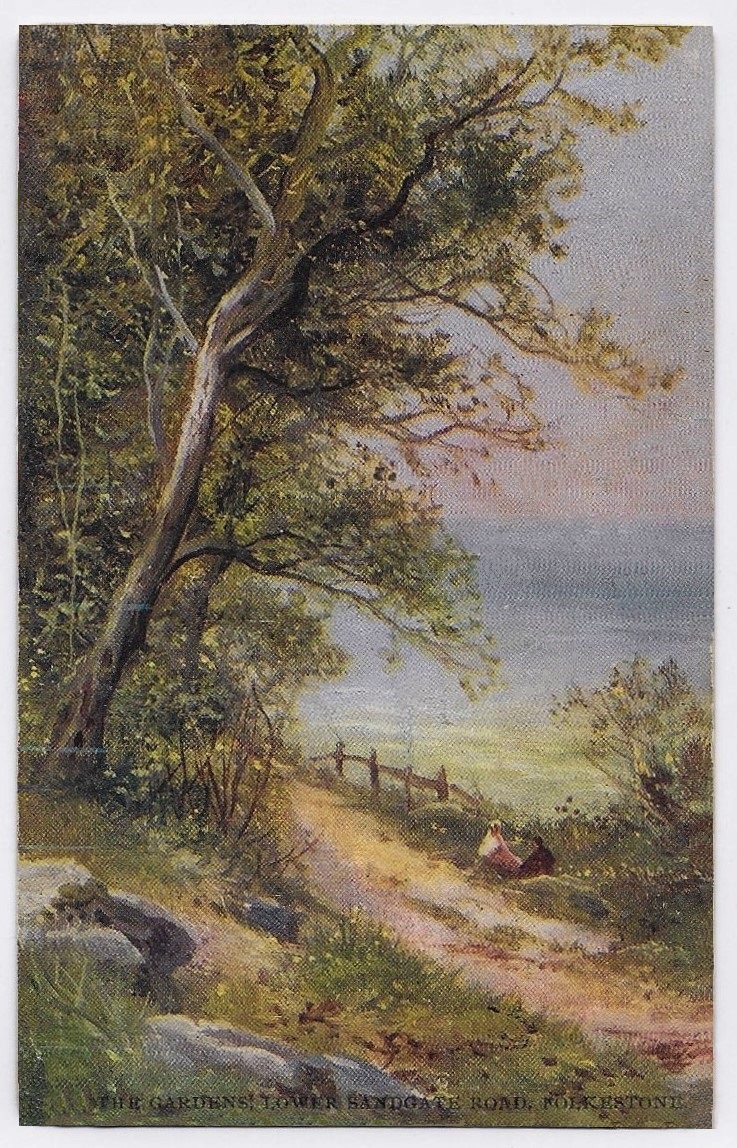
The postcard scene is printed in the “Oilette” style, which resembles a painting – in the lower left of the face, one can see the imprint of “Oilette”.
This was a patented process of Raphael Tuck & Sons, “Art Publishers to their Majesties, The King and Queen”.
The postcard was “Printed in England”.
+ + + + + +
On the reverse, John’s message omits a greeting.
The message begins, “Here is a pretty card from London town”.
John reports that he will “leave here on Thursday night with another nice group.”
It seems that John is joining tour groups according to his own itinerary.
This evening, John already “met two of them”.
The message concludes with “Best Wishes”.
Mrs. McEwen saved the postcard throughout her life.
One hopes that John continued to enjoy his journeys abroad.