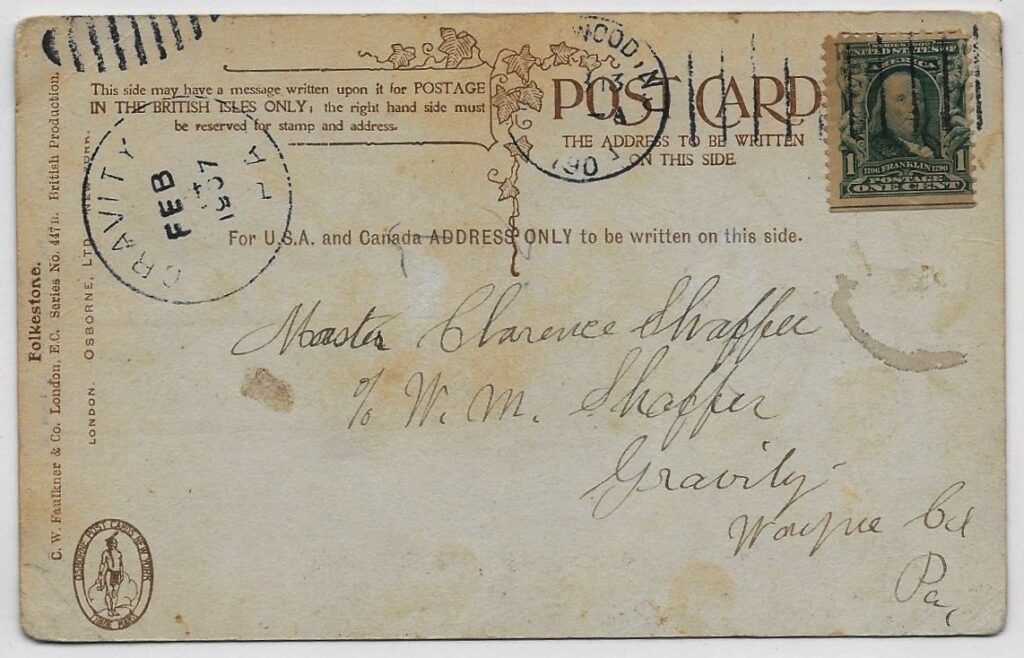
Master Clarence Shaffer lived in Gravity, once a town in the Pocono Mountains of Wayne County in northeast Pennsylvania.
https://waynecountypa.net/gravity
The community was the site of a 16-mile track begun in 1820 to carry coal, stone, and lumber across rugged terrain.
By 1850, this route was powered by a “Gravity Railroad”, which lent its name to the town.
https://en.wikipedia.org/wiki/Pennsylvania_Gravity_Railroad
Today, the community is a neighborhood of Lake Township and is known for a variety of outdoor recreational opportunities.
The post office in Gravity was closed in 1948.
https://explorepahistory.com/hmarker.php%3FmarkerId=1-A-C2.html
Clarence resided within the household of Mr. William Shaffer, presumably his father.
In February of 1907. Clarence received an art postcard from an unidentified sender.
The postmark is partially obscured; the card was mailed from some post office in New Jersey.
As it was received on February 14, the postcard may have been intended as a Valentine.
+ + + + + +
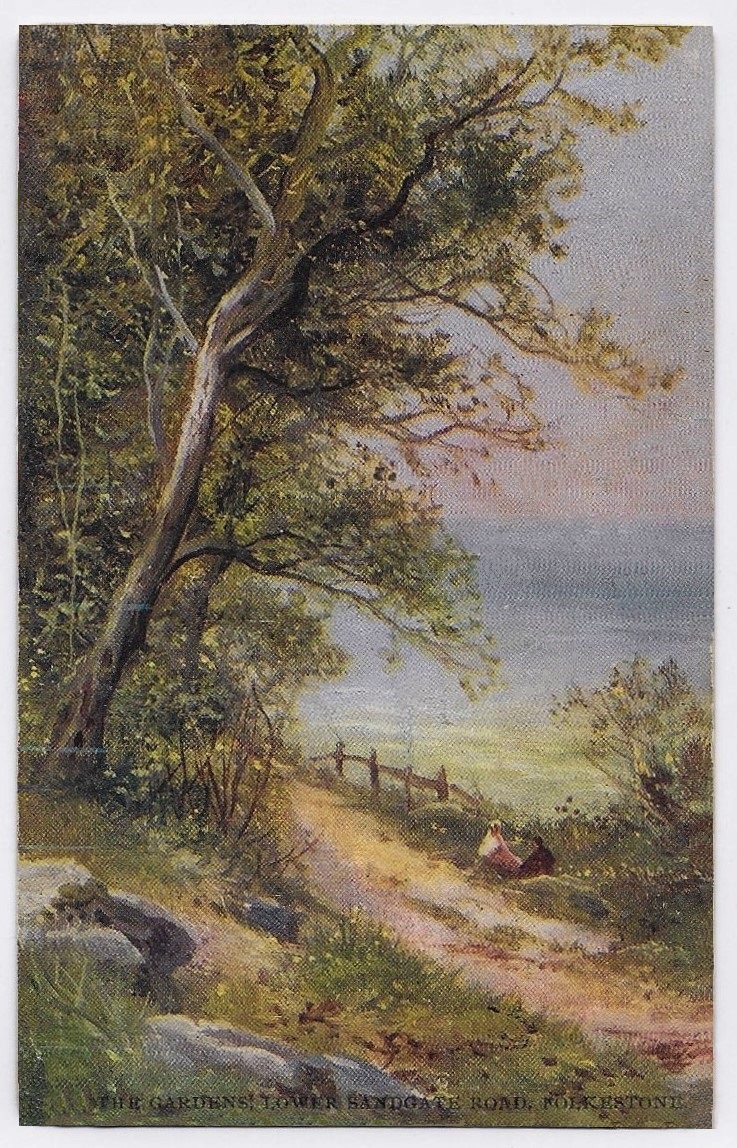
The face of the postcard is a painting of an English country road.
Ancient trees cover a hillside along which the lane winds; a fence lines the fields on the other side.
Two small figures appear to be enjoying the late summer warmth of the quiet scene.
A printed title identifies, “The Gardens, Lower Sandgate Road, Folkestone”.
Folkestone is an ancient town on the English Channel in Kent County of southeast England.
Although there is evidence of human settlement since the Mesolithic Era, Folkestone is connected to a long train of religious, commercial, and military events in recorded history.
https://en.wikipedia.org/wiki/Folkestone
After the railroad connected the coast in 1843, Folkestone became the most fashionable seaside resort for royals and aristocrats of the Edwardian age.
https://www.britannica.com/place/Folkestone
+ + + + + +
This charming example of postcard art was printed in Great Britain by the Osborne Post Card Company of London and New York.
Additional credit is given to the C. W. Faulkner Company of London – which seems to have developed the series of art scenes entitled “Folkestone”.
The unusual notice, “For USA and Canada ADDRESS ONLY to be written on this side” reflects the year circa 1906 when nations were in the process of adopting universal postcard standards permitting a “divided back”.
Clarence seems to have appreciated the English print as it was preserved throughout his life.
Although the reverse shows signs of age and decay, the face retains remarkable clarity for its age of a century and a quarter.