Mrs. C. G. Wright lived in Vicksburg, the city on the Mississippi River in west-central State of Mississippi.
https://en.wikipedia.org/wiki/Vicksburg,_Mississippi
Long a center of trade and commerce, Vicksburg was captured in a brilliant siege by Union General Ulysses S. Grant in a turning point of the Civil War.
https://en.wikipedia.org/wiki/Siege_of_Vicksburg
Sometime around 1910, Mrs. Wright received a Christmas postcard from a friend whose name I cannot decipher.
The postcard was mailed from Natchez, the city on a bluff overlooking the east bank of the Mississippi River in the southwest region of the State of Mississippi.
The first European settlement here was a French trading colony that later became a part of Spanish and British colonial possessions.
In the years before the Civil War, Natchez was the home of very wealthy slave-owning cotton planters who traded cotton and goods throughout the South.
https://en.wikipedia.org/wiki/Natchez,_Mississippi
+ + + + + +
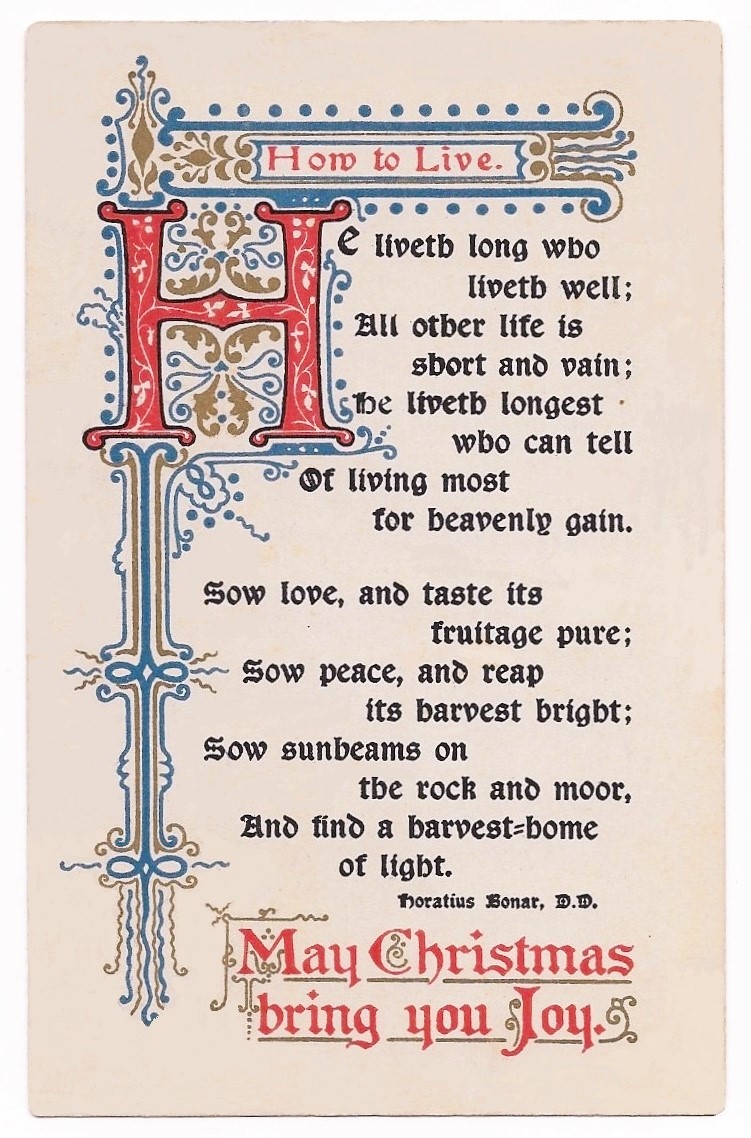
The face of the postcard is a beautifully-printed verse by a clergyman and essayist, Horatius Bonar, D.D.
Dr. Bonar was a Scotsman who became a minister in the Church of Scotland, following the footsteps of several generations of his forebears.
Bonar later joined the Free Church of Scotland and became widely-popular in the 19th century both as a preacher and as a writer and essayist.
In England and the US, Bonar was well-known as a poet and prodigious hymn-writer (e.g., “I Heard the Voice of Jesus Say” and the Communion hymn, “Here, O My Lord, I See Thee Face to Face”).
https://en.wikipedia.org/wiki/Horatius_Bonar
The brightly colored capitals, ornate frame, and antique fonts recall the Arts & Crafts movement of the 19th century.
The first set of rhyming couplets asserts that the best life, the longest life, is the one “living for heavenly gain”.
The second set of couplets exhort one to “sow love” and to “sow peace”.
The verse was copyrighted by the E. P. Dutton Co. of New York.
The postcard was printed in Bavaria and published by the English firm of Ernest Nister.
+ + + + + +
On the reverse, the sender begins the message without a greeting – “Trust this finds you well”.
It appears that Mrs. Wright has not heard from her friend recently, as the writer adds, “Have not forgotten you although not communicated for a little time”.
The message was sent “fondly”.
Mrs. Wright seems to have loved the Christmas remembrance as the postcard was preserved in decent condition for a century.
(Below, the image of the reverse shows the severe foxing that also marred parts of the face.)
One hopes that friends and family members of Mrs. Wright and those of her correspondent in Natchez enjoyed a wonderful Christmas.