As we approach the 250th Anniversary of the Declaration of Independence, there has been renewed interest in the events and personalities of the American Revolution.
This year is also the 201st anniversary of the celebratory tour made by the Marquis de Lafayette through the United States in 1724-1725.
https://en.wikipedia.org/wiki/Marquis_de_Lafayette
Only 19 years old when his idealistic fervor led him to leave France in order to aid the beleaguered Continental Army, Lafayette lived long enough to observe the development of America fifty years after independence.
During that tour, Lafayette was feted in cities and towns across the nation, including at a great banquet in Lancaster, Pennsylvania (the site of the reception is still standing near the square).
Boston, Philadelphia, and New York strove to outdo one another in public demonstrations, and Lafayette was accompanied by a ceremonial honor guard in every State he visited.
He was the last living officer of the Continental Army.
https://en.wikipedia.org/wiki/Visit_of_the_Marquis_de_Lafayette_to_the_United_States
Nevertheless, when I found this postcard in a box of old paper, I was confused – I was not aware of any building connected to Lafayette in Rhode Island.
+ + + + + +
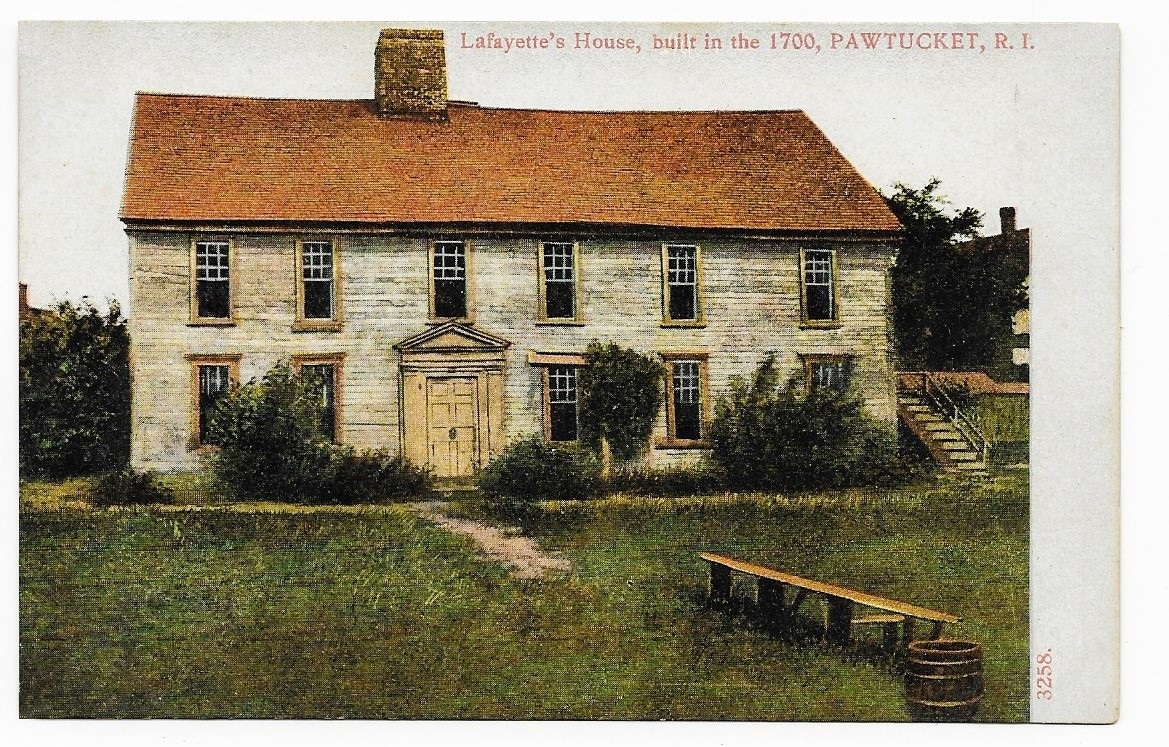
The face of the postcard shows a weathered house, apparently uninhabited, behind an untidy lawn and untrimmed bushes.
A printed legend identifies this as “Lafayette’s House, built in the 1700 (sic)”.
The location is given as “PAWTUCKET, R. I.”
Pawtucket, a city adjacent to the city of Providence and to the Massachusetts town of Attleboro, was an early center of textile manufacturing.
https://en.wikipedia.org/wiki/Pawtucket,_Rhode_Island
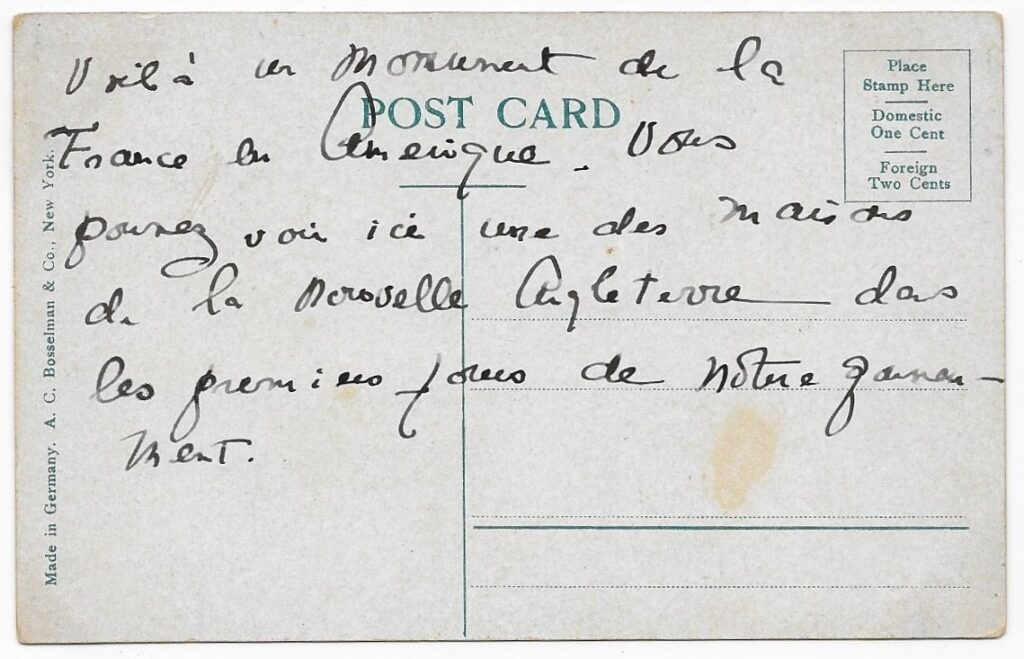
The postcard was published by A. C. Bosselman & Co. of New York, and was “Made in Germany”.
This building, constructed circa 1750, was used briefly as the headquarters of Lafayette during his posting to secure the area against British incursion in 1778.
I cannot find a contemporary view or description of the building, and suspect that it has not survived.
+ = + + + +
The postcard was not mailed, but appears to have been preserved by a francophone collector.
The inscription on the reverse is in French.
The writer notes, “See a monument to France in America”.
The message continues, “You can see here one of the houses of New England … (and I am unable to render the rest of the inscription).
Although the date is not preserved, the provenance of the postcard is clearly circa 1910.
The collector seemed thrilled to find a celebration of French participation in the American Revolution.