Miss Elizabeth Amelia (possibly Aurelia) Murray lived in McAlester, a city and county seat of Pittsburg County in southeast Oklahoma.
McAlester grew up around the junction of two early roads – the east-west California Road and the north-south Texas Road.
https://en.wikipedia.org/wiki/McAlester,_Oklahoma
Today, McAlester is the site of a large Army munitions plant and an enormous State Prison.
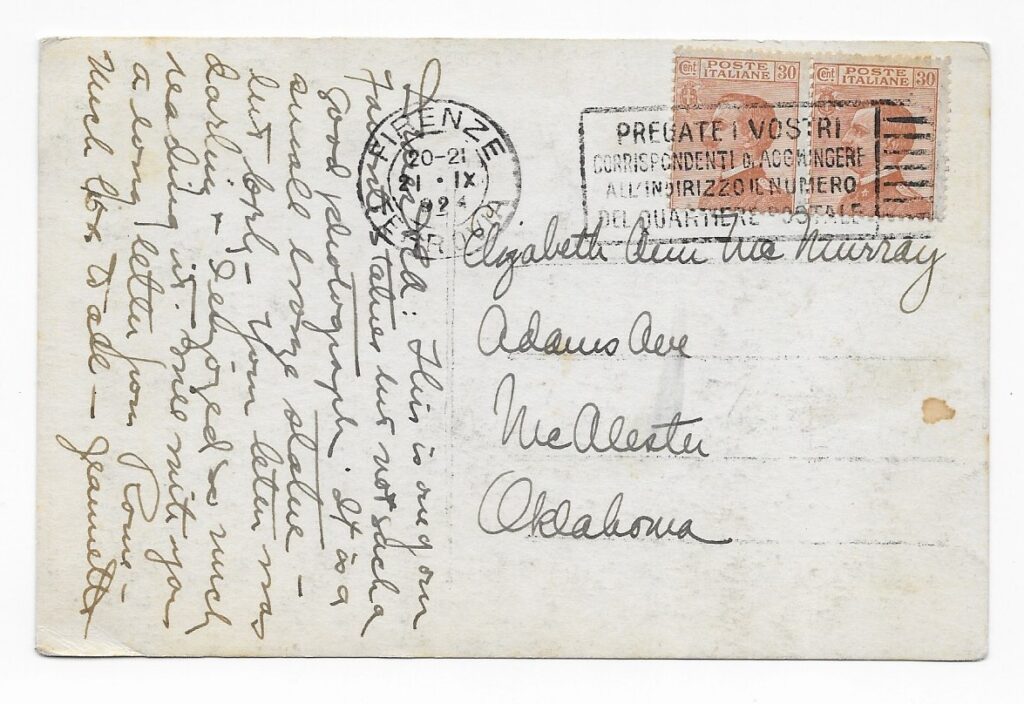
In September of 1924, Elizabeth received a postcard from her friend, Jeannette.
The postcard was mailed from Florence, the great center of Italian Renaissance arts and philosophy, and once the site of an experiment in a Republican form of government.
https://en.wikipedia.org/wiki/Florence
Since the 15th century, this capital of Tuscany has lured students and visitors to study the vast quantity of artistic treasure preserved there.
https://treasuresofflorence.wordpress.com
+ + + + + +
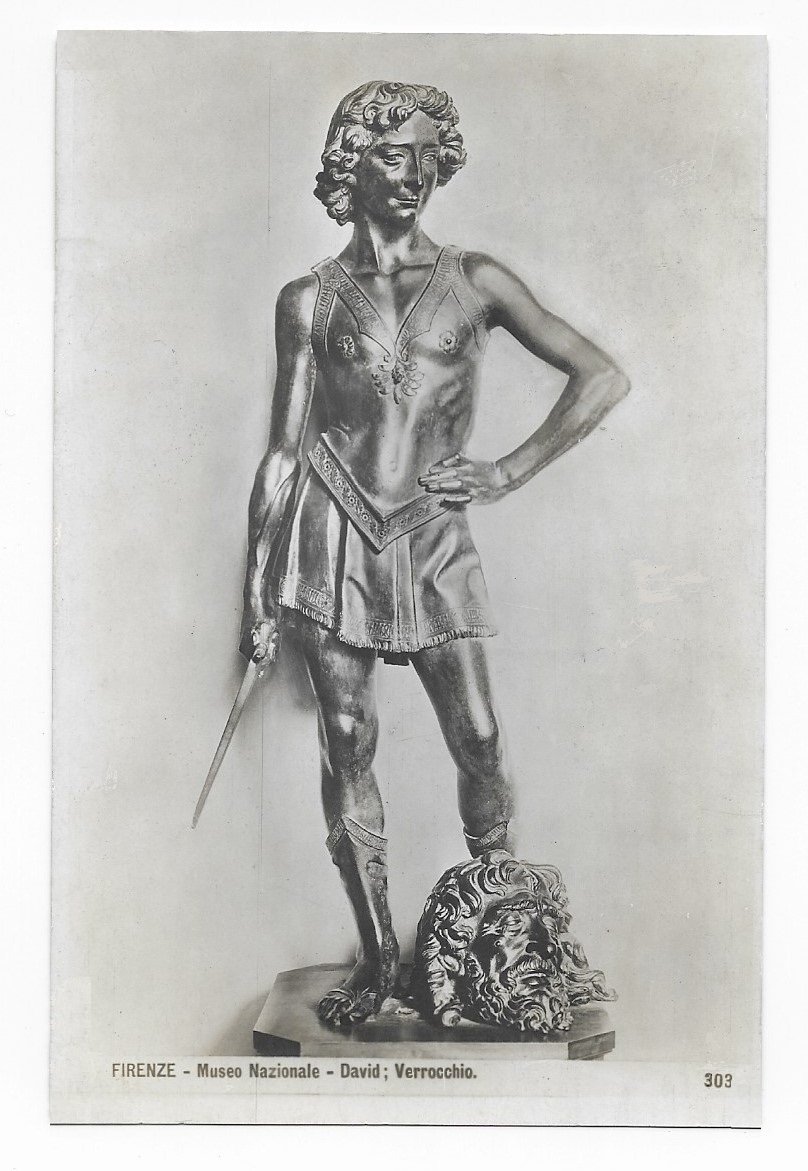
The face of the postcard is a photograph of a bronze statue by Verrocchio, a very young David standing over the giant head of Goliath.
Andrea del Verrocchio was commissioned by the Medici family to create the work between 1473 and 1475.
https://en.wikipedia.org/wiki/Andrea_del_Verrocchio
This work is a stunning contrast to Michelangelo’s David” (also in Florence), which shows an older, more developed and more serene figure holding only a sling.
In contrast, Verrocchio’s David still holds the sword that severed the head of the giant, and his posture shows the sinewy form of a boy.
Unthinking viewers get lost in conversation about which statue is “better”, but the sculptors had very different conceptions of the hero.
The postcard photograph does not do justice to the original – shadows obscure one side of the face.
https://en.wikipedia.org/wiki/David_(Verrocchio)
+ + + + + + +
On the reverse, Jeannette greets “Dearest EA”.
She immediately launches into praise of the statue on the face – “This is one of our favorite statues”.
Jeannette observes truly, “not such a good photograph.”
She adds, “It is a small bronze statue, but lovely”.
A letter from EA was “darling” and Jeannette “enjoyed so much reading it.”
From Rome, Jeannette promises to “…write a long letter”.
The postcard was sent with “Love to all”.