Miss Grace Swasey resided in Wells, a coastal town in York County of southeast Maine.
The area around Wells, including Kennebunk, was part of a land grant awarded by the Plymouth Company of England in 1641.
https://en.wikipedia.org/wiki/Wells,_Maine
(The Massachusetts Bay Colony claimed the territory until 1820).
First an agricultural community with a mill, then a center of ship-building and fisheries, Wells became a resort center with the coming of the railroad.
This postcard photograph is from the Wiki:
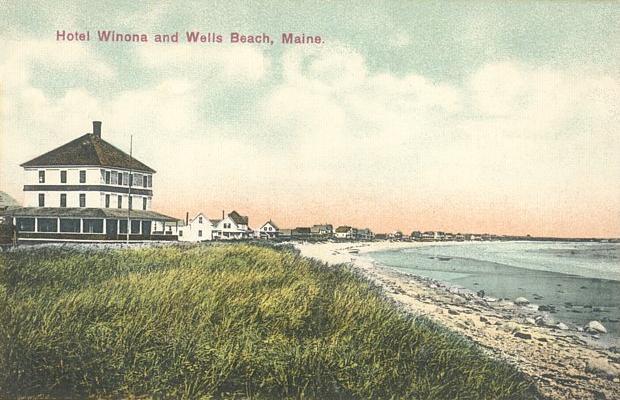
Wells remains a popular summer resort today and is still served by a railroad station (Amtrak).
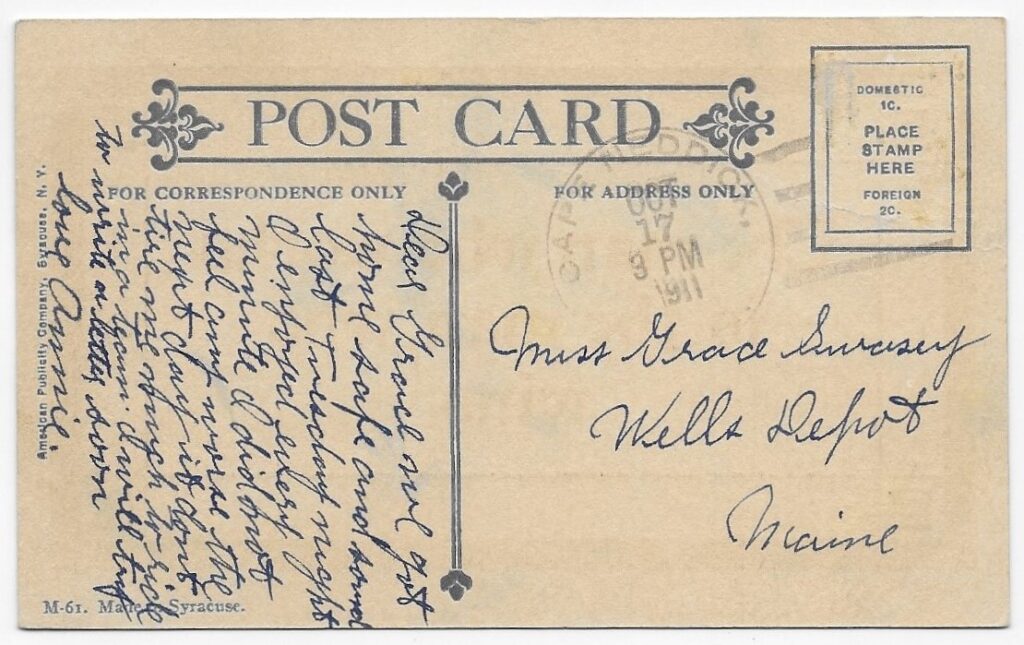
In October of 1911, Grace received a postcard from Annie.
The postcard was mailed from Cape Neddick, an unincorporated community on the Cape Neddick peninsula in York County, Maine.
https://en.wikipedia.org/wiki/Cape_Neddick,_Maine
Cape Neddick is on the Atlantic coast, almost 12 miles south of Wells.
+ + + + + +
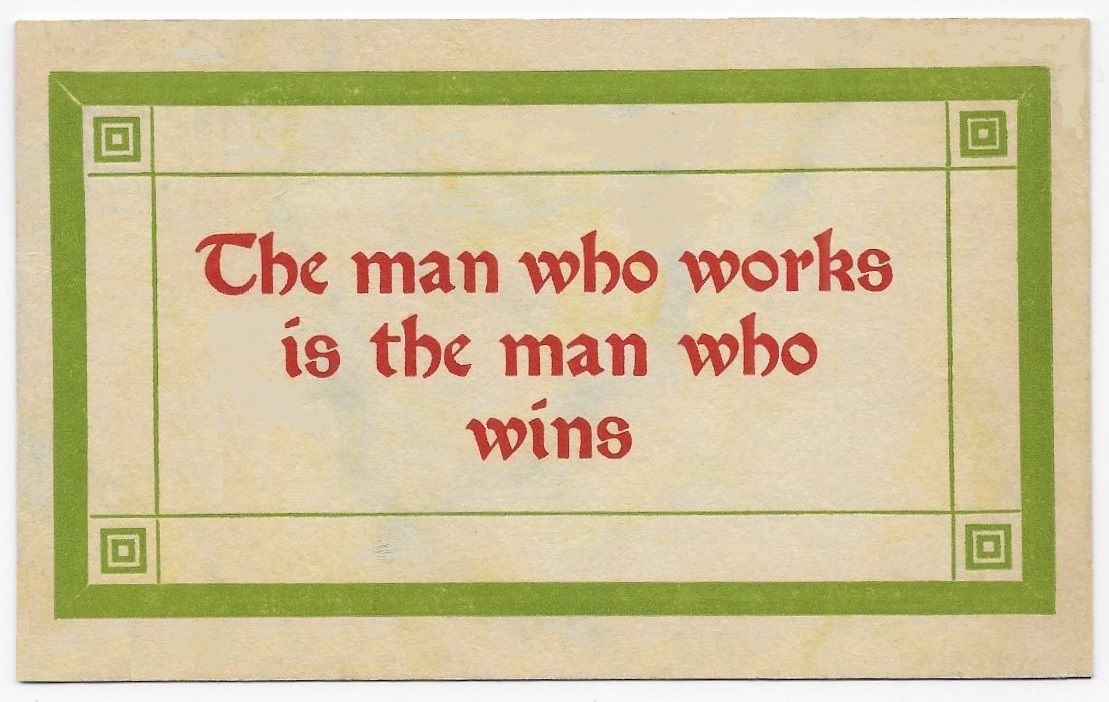
The face of the postcard is a motto printed within a green frame embellished with additional linear decoration.
Bright red letters assert “The man who works is the man who wins”.
This sentiment, often expressed as an exhortation to “work hard” or to celebrate “hard work” has been a bedrock of American enterprise.
The Google Summary:
The belief in hard work is a foundational cultural and moral value that ties effort to personal achievement, character, and success.
Meritocracy myth: Society often promotes the idea that anyone can rise through determination regardless of starting point.
Historical roots: Thinkers like Max Weber linked the Protestant work ethic to personal responsibility and economic success.
Resilience: A deep-seated work ethic encourages individuals to view failures as growth opportunities rather than endpoints.
The simplicity of the postcard assertion is a bit harder to defend when considering all the social and political factors that impede “winning” – such as stagnant wages, economic or social disadvantage, monopolization of industry, etc.
Published by the American Publicity Company of Syracuse, NY, the postcard was “Made in Syracuse”.
+ + + + + +
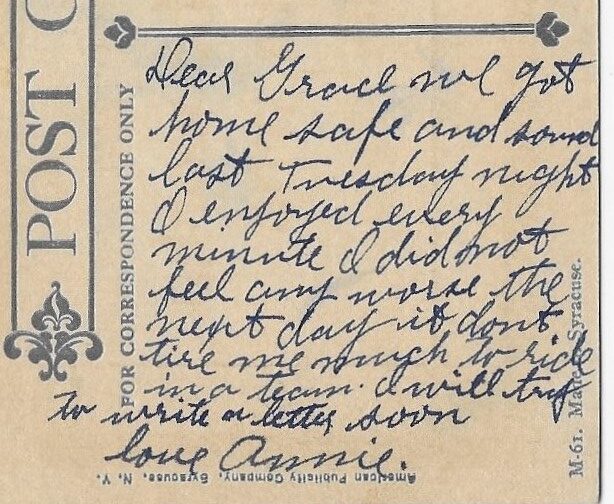
On the reverse, Annie greets “Dear Grace” and reports, “we got home safe and sound last Tuesday night”.
There seems to have been a social event or meeting as Annie gushes, “I enjoyed every minute”.
Annie may suffer from some recurring malady as she notes, “I did not feel any worse the next day” and “it don’t (sic) tire me much to ride in a train.”
The message closes with Annie’s promise to write a letter soon.
Grace preserved the postcard throughout her life – there is noticeable foxing and fading across much of the face, although I digitally removed most of the errant ink marks made by mail transit.
One hopes that Annie continued to enjoy reasonable health and that she composed a letter to Grace as promised.