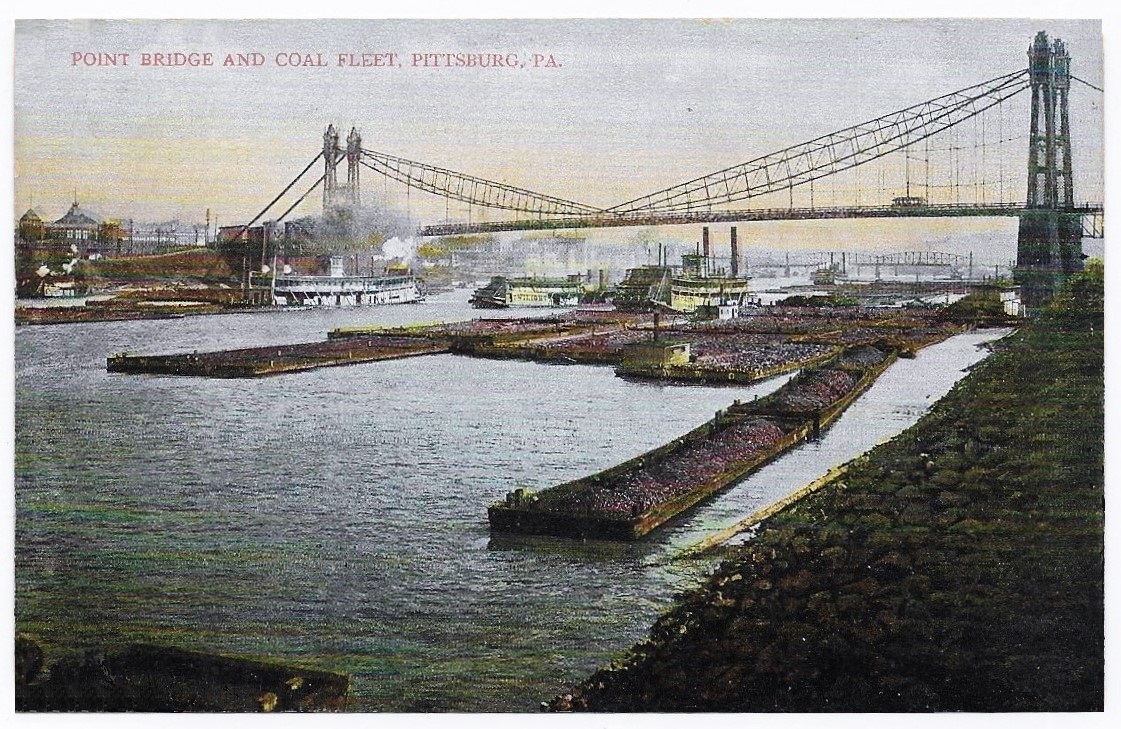
This postcard was neither addressed nor mailed, but reflects an important part of US history.
At the turn of the 20th century, the growth of the nation depended upon the continued exploitation of natural resources – especially coal and iron ore.
Although Pennsylvania had modest deposits of iron ore which had been mined and forged since colonial times, the Commonwealth had enormous resources of coal.
In northeast PA, the extractions from the “Anthracite Region” fed the growth of Scranton, Wilkes-Barre, Hazelton, and Pottsville – and supported the initial growth of the Reading Railroad which sent coal to Philadelphia and New York.
https://en.wikipedia.org/wiki/History_of_anthracite_coal_mining_in_Pennsylvania
In the west, the “Pittsburgh Seam” of coal (stretching into Ohio and Maryland) was the largest mineral deposit in the Appalachian Mountains.
https://files.dep.state.pa.us/mining/BureauOfMiningPrograms/BMPPortalFiles/dcnr_008139.pdf
When Pennsylvania could no longer supply adequate amounts of iron ore to feed the many furnaces of Pittsburgh, the Iron Range of Minnesota sent shiploads of ore through the Great Lakes to Cleveland where the ore was loaded on freight trains for the short journey to Pittsburgh.
Pittsburgh became “Steel City”, the largest steel-producing center of the US and it boasted the third-highest number of corporate offices (after New York and Chicago) in the early 20th century.
https://www.pbs.org/wgbh/americanexperience/features/foster-pittsburgh-becomes-city-steel
The fortunes of the Frick, Carnegie, and Mellon family (among others) were made in the industrial boom of Pittsburgh.
https://en.wikipedia.org/wiki/Economy_of_Pittsburgh
+ + + + + +
In this postcard photograph, we see the “Point Bridge and Coal Fleet” in Pittsburgh.
The Point Bridge was an early suspension bridge over the Monongahela River that was constructed in 1877.
This bridge was replaced in 1927, and the replacement bridge was demolished after the opening of the Fort Pitt Bridge in 1959.
Here, the river is choked with huge barges of coal; the smoke from furnaces and foundries can be seen rising in the background.
The postcard was published by Kresge & Wilson; it was “Printed in Germany”
+ + + + + +
Ironically, the nation’s first oil well was constructed in Pennsylvania – and that development prefigured the great energy shift toward oil and gas production that defined industrial development of the late 20th century.
It would be fitting if Pennsylvania continued its tradition by becoming a leader of renewable energy production.