We met members of the Long family in earlier postcard stories:
“Ohio River Steamboat at Night” (1906), “A Pointed Suggestion” (1906), “Chester Sends a Blond Archer” (1909).
D. A. Long was living in Shippensburg, an historic borough in Cumberland and Franklin Counties of south-central Pennsylvania.
The community was named for Edward Shippen, prominent colonial resident of Philadelphia and Lancaster, who received a land patent from the heirs of William Penn.
The first setters were Scots and Irish immigrants who arrived in 1730.
https://en.wikipedia.org/wiki/Shippensburg,_Pennsylvania
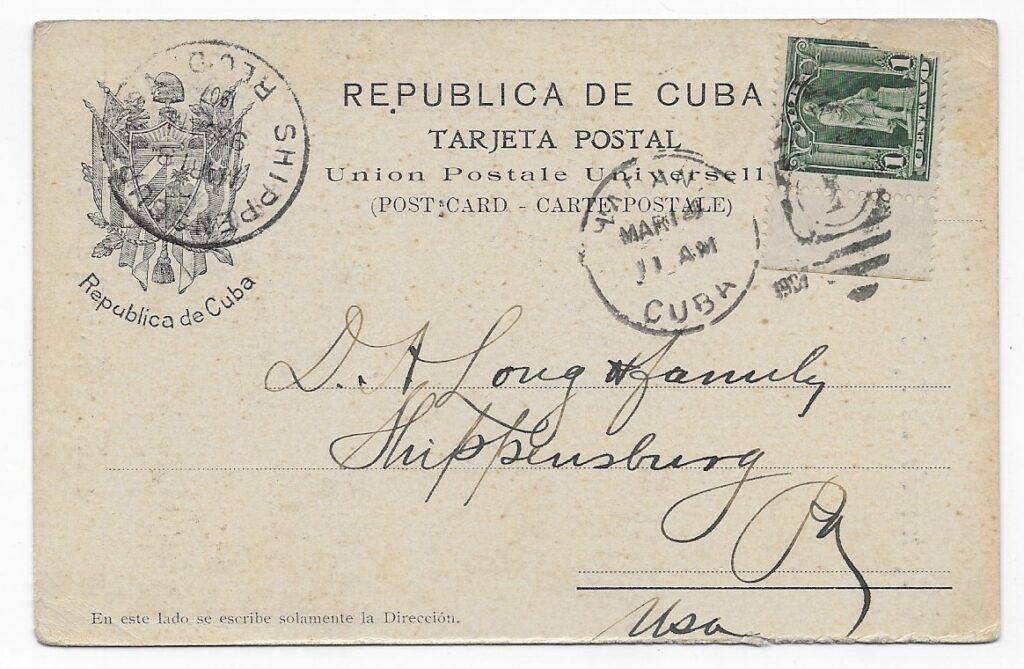
In March of 1907, the Long famiy received a postcard from an unidentified correspondent.
The postcard was mailed from Havana, the colorful and prosperous coastal capital of Cuba.
https://en.wikipedia.org/wiki/Havana
At the end of the Spanish-American War (1898), Cuba was occupied by US troops until 1902.
Although Cuba was declared a Republic, the United States exerted economic and political controls resembling colonial powers = including two later occupations by US troops.
US businesses dominated essential industries, and the English language was widely spoken.
https://en.wikipedia.org/wiki/United_States_occupation_of_Cuba
Tourism flourished as ships carried throngs of visitors to this inexpensive Caribbean capital.
From the Google Summary:
Following the Spanish-American War in 1898, US tourism to Cuba experienced rapid growth, transforming the island into a major leisure playground for wealthy Americans and thrill-seekers. This era was characterized by distinct historical periods, shifting from early US political dominance to hedonistic escapism, and ultimately to the severe modern travel restrictions currently in place
+ + + + + +
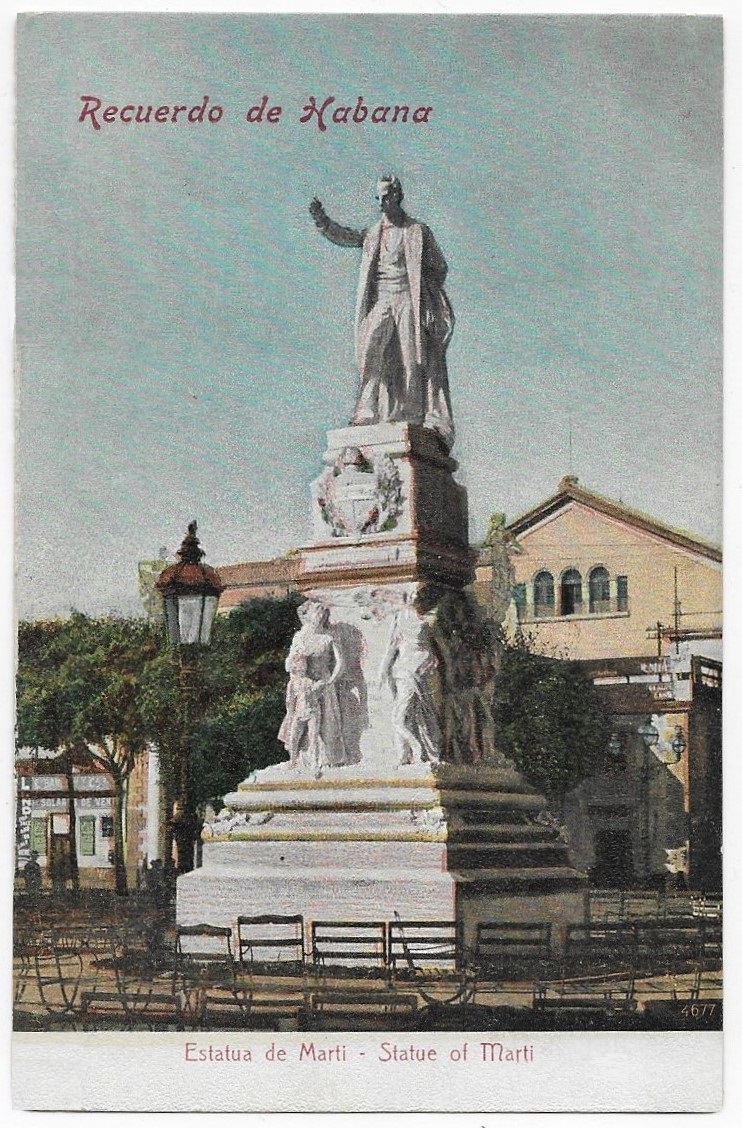
The face of the postcard is a photograph of “Estatua de Marti” (Statue of Marti), showing a marble figure standing atop a tiered monument.
Jose Marti (1853-1895) was a brilliant poet, philosopher, essayist, professor, and translator who is recognized as a giant of Latin American literature.
His tireless advocacy (and organization of nationalist and émigré communities) for Cuban independence led to his title of “Apostle of Cuban Independence”.
He died in an armed struggle with colonial forces, and is memorialized in several places in Havana (and in many countries of the world, including the US).
https://en.wikipedia.org/wiki/Jos%C3%A9_Mart%C3%AD
The statue pictured here was the first one honoring Marti in Havana – it was erected in the Pargue Central during1905.
From the Google Summary:
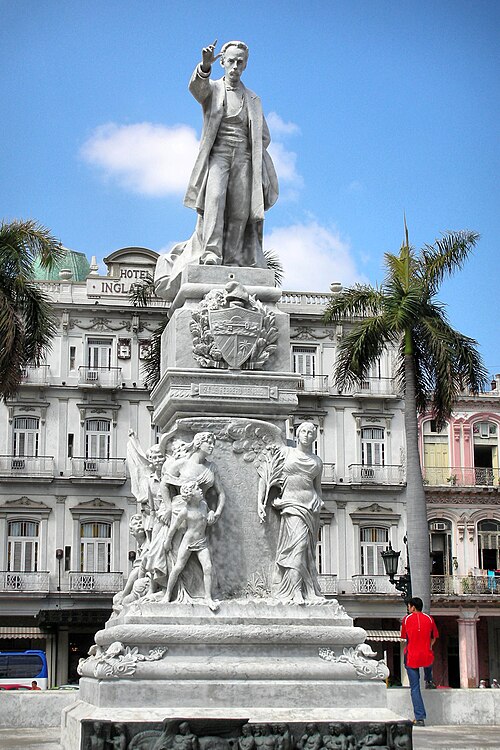
The first public statue of José Martí in Havana was inaugurated on February 24, 1905, and stands in the center of Parque Central in Old Havana.
The Sculpture was created by the Cuban sculptor José Vilalta y Saavedra, the white marble statue depicts Martí pointing toward the future.
This contemporary photograph is shared from Wiki:
The postcard was printed in Cuba; the identification of “Carte Postale” is included on the reverse.
+ + + + + +
On the reverse, there is no written message.
The year 1907 was a transition to the modern “divided back” postcard, and this postcard was printed without a space for correspondence.
We assume that Mr. Long and his family could identify the sender.
One hopes that the traveler had a safe return and shared interesting tales of Cuba.