Miss Meta Jo McAllister was growing up in Glendale, the city abutting Phoenix in Maricopa County of southwest Arizona.
Glendale was created in the desert when a forty-mile canal brought water to the area in 1885.
https://en.wikipedia.org/wiki/Glendale,_Arizona
We met Meta Jo (and other members of the McAllister family) in earlier postcard stories:
“The Guadalupe Range” (1946), “The Adobe Firehouse at Socorro” (1940), “Shakespeare Garden in City Park” (1937), “Harry is Driving to Seattle” (1934), and “A Sunday Visit to Mexico” (1938).
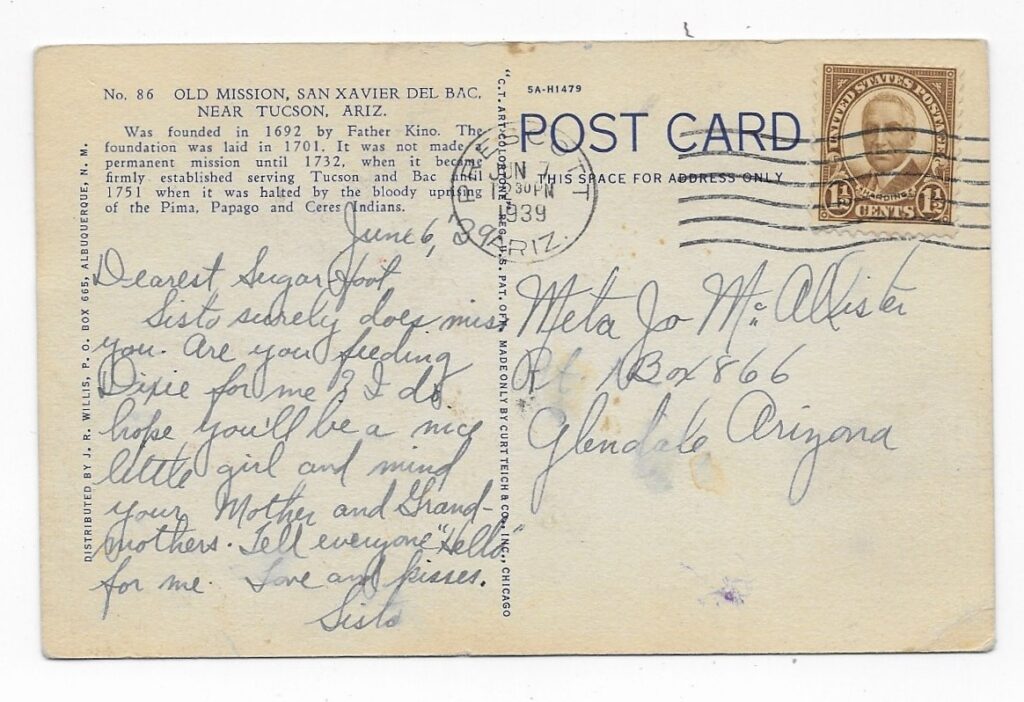
In June of 1939, Meta Jo received a postcard from “Sisto” who appears to be a relative, perhaps an older sister.
The postcard was mailed from Prescott, a city and county seat of Yavapai County in west-central Arizona.
Prescott had been a military post on the territorial frontier, a center of gold and silver mining, and exemplified the swashbuckling, free-wheeling stereotype of the “Wild West” into the beginning of the 20th century.
https://en.wikipedia.org/wiki/Prescott,_Arizona
Glendale is about 96 miles south of Prescott.
+ + + + + +
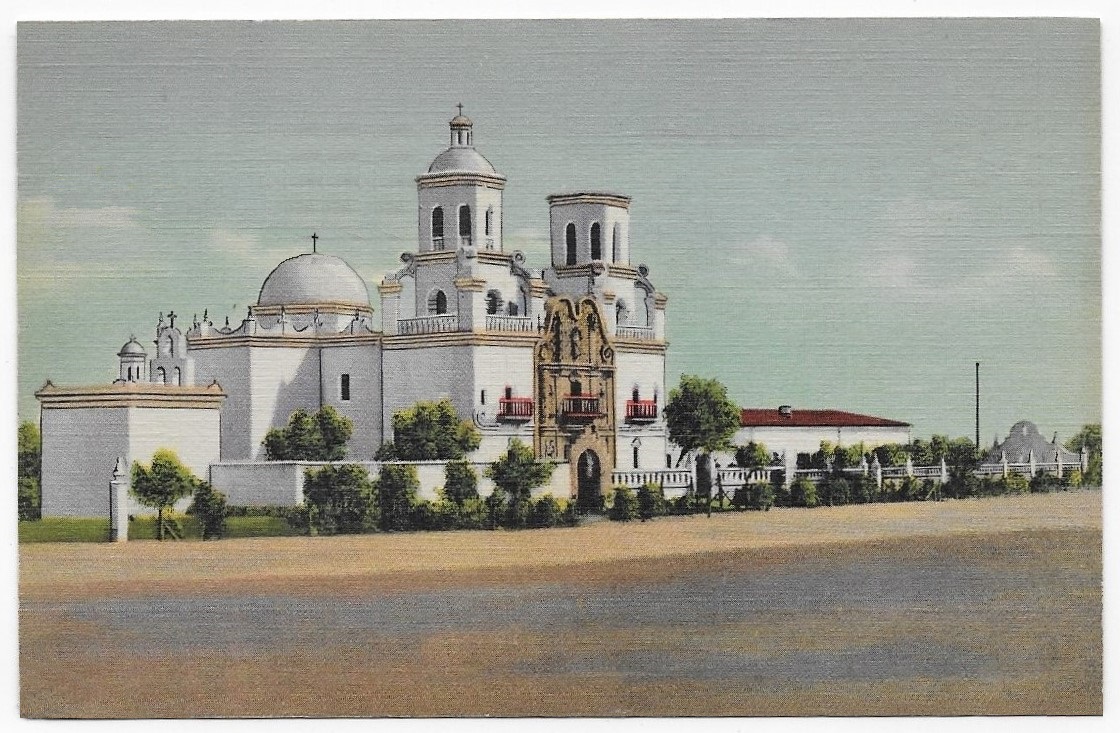
The face of the postcard is a painted depiction of the “Old Mission, San Xavier Del Bac”.
The postcard blurb notes that the Mission was established by Father Kino in 1692,
At that time, all of what is now the southwestern US was part of the Spanish colonial empire
The foundation for the Mission Church was laid in 1701 to serve the communities of Tucson and Bac.
https://www.nps.gov/places/mission-san-xavier-del-bac.htm
Like many ecclesiastical endeavors during colonization, the work was impeded and stained by revolts of indigenous peoples.
(King Charles II of Spain suppressed the Jesuit Missions in 1767 because he found them “unreliable” in assisting the colonial government in the political subjugation of the native people.)
(The 1986 movie, “The Mission”, portrays a parallel effort to suppress the Jesuit building of self-sustaining communities in South America.)
The large Church on the face was reconstructed by Franciscans between 1783 and 1797).
Today, the mission remains an active parish, a pilgrimage site, and the location of indigenous festivals and processions.
The postcard was printed in the patented “Art Colortone” process of the Curt Teich Company of Chicago.
It was distributed by J. R. Willis of Albuquerque, New Mexico.
+ + + + + +
On the reverse, Meta Jo is addressed as “Dearest Sugarfoot”.
The writer declares, “Sisto surely does miss you” and asks, “Are you feeding Dixie for me”.
Meta Jo is encouraged to “be a nice little girl and mind your Mother and Grandmothers”.
The message concludes with “Love and Kisses”.
Meta Jo preserved the postcard, along with a vast collection of family correspondence, throughout her life.
One hopes that Dixie was fed, that Meta Jo behaved sweetly, and that Sisto soon saw “Sugarfoot” again.