More than a century after his death, the name of P. T. Barnum remains synonymous with the successful effort to amuse and entertain the public with spectacle and subterfuge.
In 1810, Phineas Taylor Barnum was born in Bethel, a town in Fairfield County of southwest Connecticut,
After an initial career as a small business owner and newspaper publisher, Barnum moved to New York City and became an entertainment entrepreneur.
https://en.wikipedia.org/wiki/P._T._Barnum
The variety troupe, “Barnum’s Grand Scientific and Musical Theater” was succeeded by a new venture, the purchase of Scudder’s American Museum.
Barnum named the new venture after himself and exhibited a variety of natural wonders, including human curiosities and hoaxes.
To modern sensibilities, the exposure of human physical anomalies appears crass and cruel, but the practice had a long history in America and many other parts of the world.
The Barnum enterprise continually innovated, adding daily balloon rides, New York’s first Aquarium, automatons, and a wax works.
https://en.wikipedia.org/wiki/Barnum%27s_American_Museum
(Barnum was an outspoken supporter of the Union cause during the Civil War, and his New York City Museum complex was destroyed by Confederate sympathizers in 1864.)
After making a fortune from the American Tour of Jenny Lind in 1850, Barnum made a series of unwise investments.
To recover from devastating losses, Barnum toured widely in the 1850’s as a Temperance advocate and produced a Temperance-themed play, “The Drunkard”.
To overcome the poor reputation of theaters, Barnum built the largest and most modern theater in New York, initiated matinee performances and added “Moral Lecture Rooms”.
Barnum’s appetite for showmanship is widely-remembered for the elaborate hoaxes (e.g., “The Fuji Mermaid”), but much of his career was devoted to creating audiences for mundane entertainments – dog shows, flower shows, beauty pageants, poultry pageants, and historical reenactments.
+ + + + + +
In the 1860’s Barnum served two terms in the Connecticut legislature where he gave an impassioned speech in support of the 13th Amendment which abolished slavery:
“A human soul, ‘that God has created and Christ died for,’ is not to be trifled with. It may tenant the body of a Chinaman, a Turk, an Arab, or a Hottentot—it is still an immortal spirit.“
In his career, Barnum also embraced “high culture” – Barnum bought the Museum of Rembrandt Peale which became (after several incarnations), “Baltimore’s Community Museum”.
https://en.wikipedia.org/wiki/Peale_Museum
Barnum made generous gifts to Tufts University, and supported many public charities.
+ + + + + +
In 1875, Barnum was elected Mayor of Bridgeport, and was regarded as an effective and successful public servant.
He founded, and was the first President of the Bridgeport Hospital.
At 60 years of age, Barnum also founded a circus – which later evolved to become the “Barnum & Bailey, Ringling Brothers Circus” which was the only entertainment business that survived him.
https://en.wikipedia.org/wiki/Ringling_Bros.and_Barnum%26_Bailey_Circus
The circus train, and the parade of animals through urban streets were initiated by Barnum.
On April 7, 1891, Barnum died at his mansion in Bridgeport.
He was buried in Mountain Grove Cemetery, which he designed and bequeathed to the city.
https://en.wikipedia.org/wiki/Mountain_Grove_Cemetery,_Bridgeport
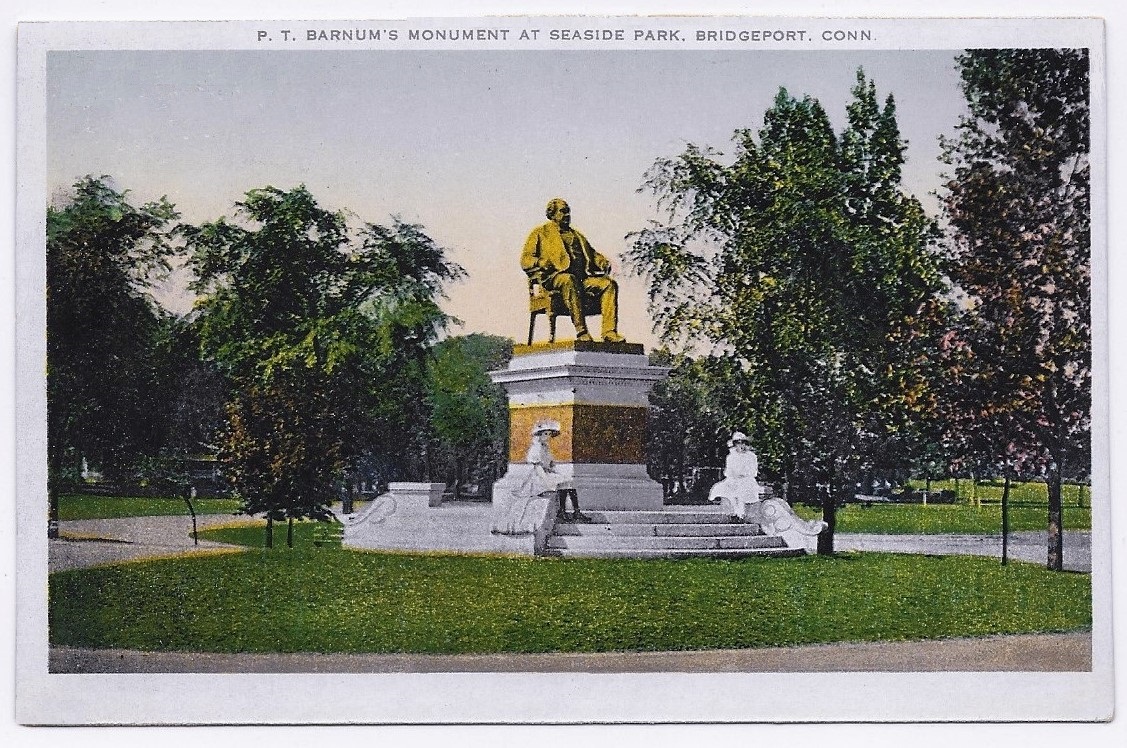
Two years later, former partners of Barnum erected a monument to this innovative and passionate man.
+ + + + + +