Although his music is still widely-recognized today, the reputation of Stephen Collins Foster is more complicated than it was when he was a national celebrity during the 19th century.
Then, Foster’s infectious tunes and his appeals to sentiment and nostalgia made him a leading figure in popular culture.
Foster was amazingly prolific, composing new “hits” with startling frequency.
He was also an intuitive showman.
https://en.wikipedia.org/wiki/Stephen_Foster
+ + + + + +
In the United States, the period following the Civil War was marked by widespread hardship – a larger proportion of the nation’s families had suffered direct loss than in any other war of US history.
https://rsc.byu.edu/civil-war-saints/civil-wars-aftermath-reconstruction-abolition-polygamy
At the same time, the economy was punctuated by cycles of boom and bust that raised expectations and increased risks.
Although Foster had died before the end of the Civil War, his songs with themes of nostalgia for an idealized past, celebration of endurance, memories of lost love, and attachment to nature and the land – and were widely-embraced through the post-War period.
At the same time, Foster’s appropriation of the experience of Black Americans was devoid of any reference the horrors of Slavery.
https://www.npr.org/transcripts/126035325
Although Foster’s own racial sentiments are not well-documented, the songs (“Swanee River”, “My Old Kentucky Home”, “Old Black Joe”, etc.) gave ammunition to the “Lost Cause” partisans who seized upon the trope of happy plantation life, the contented slave, and a harmonious social order in the Old South.
https://academic.oup.com/book/60544/chapter/523473979
+ + + + + +
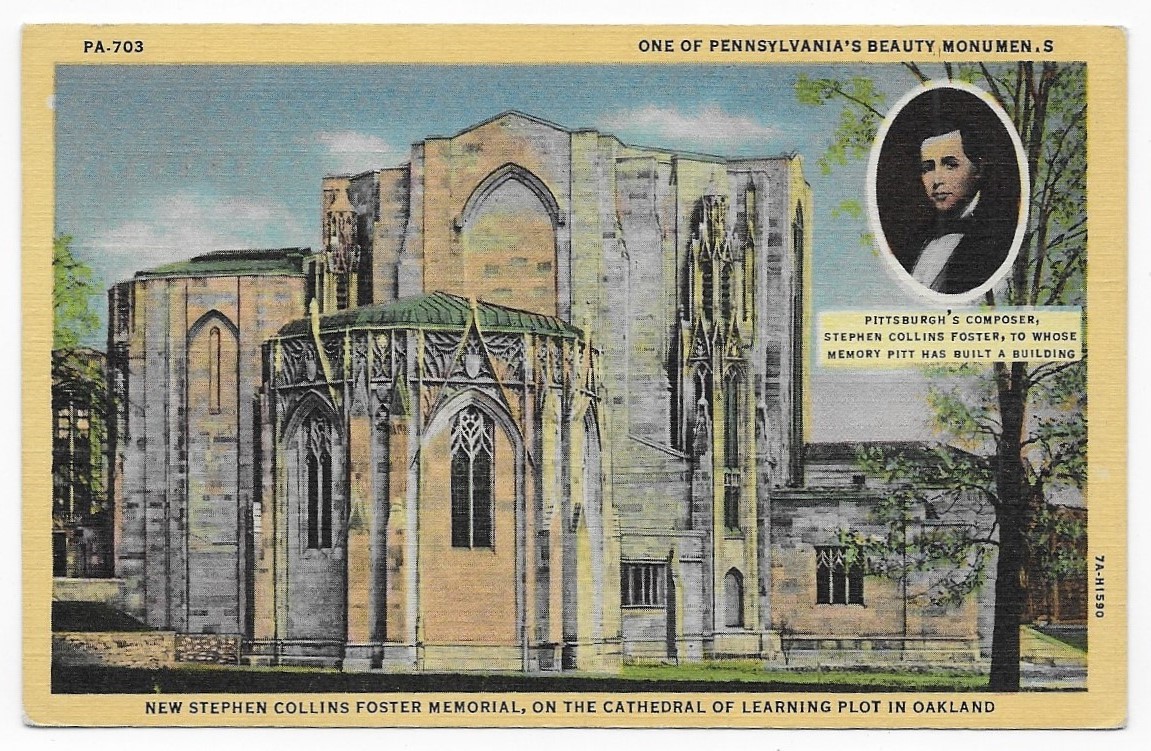
The face of the postcard is a drawing of the “New Stephen Collins Foster Memorial on the Cathedral of Learning plot in Oakland”.
Beside the depiction of the memorial structure, a medallion portrait of Foster has this caption: “Pittsburg’s composer, Stephen Collins Foster, to whose memory Pitt has built a building.”
And, above the scene, a legend in the margin notes: “One of Pennsylvania’s Beauty Monuments”.
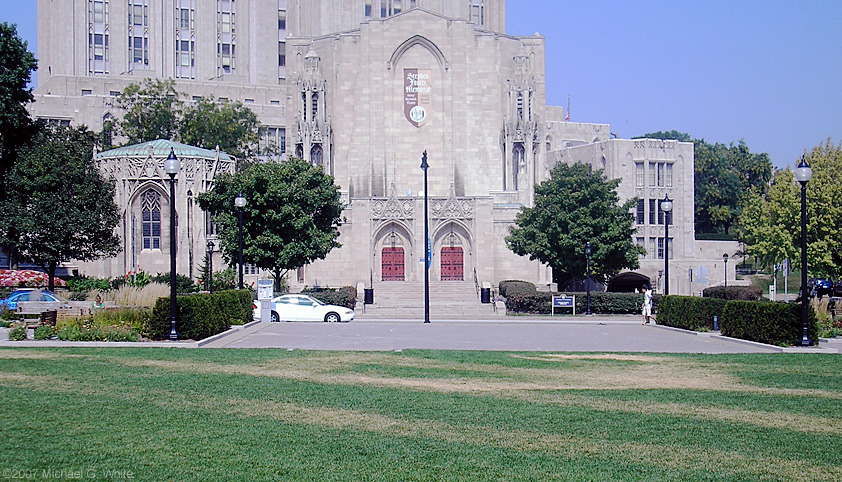
The Stephen Foster Memorial is a Performing Arts Center and Museum on the campus of the University of Pittsburgh.
https://en.wikipedia.org/wiki/University_of_Pittsburgh
The main structure houses two theaters, and the Stephen Forster Memorial Museum and Center of American Music.
Constructed on a steel frame and encased with Indiana limestone, the building was designed by architect, Charles Klauder in 1935.
https://en.wikipedia.org/wiki/Stephen_Foster_Memorial
After its dedication in 1937, the building was landmarked by the city of Pittsburgh and the Commonwealth of Pennsylvania.
This postcard photograph was published by Minsky Brothers, Inc. of Pittsburgh.
I believe that it was printed at the time of the building’s dedication.
Here is a contemporary photograph of the structure shared on Wikipedia Commons: